Pros and Cons of a First Mortgage HELOC | Is It Worth It?
A Tulsa homeowner may consider replacing a traditional mortgage with a flexible credit line, while a Broken Arrow homeowner may want to fund renovations in stages. In either case, understanding the Pros and Cons of a First Mortgage HELOC is essential before changing debt secured by the home.
A First Mortgage HELOC may provide revolving equity access, but it can also bring variable rates, changing payments, fees, reborrowing, and foreclosure risk. “First mortgage” mainly describes lien priority; it does not guarantee lower costs, easier approval, or faster payoff.
Its suitability depends on the existing mortgage, equity, income, account terms, repayment plan, and rate tolerance. This guide covers the structure, benefits, risks, qualification, costs, alternatives, and realistic Oklahoma homeowner situations.
What Are the Pros and Cons of a First Mortgage HELOC?
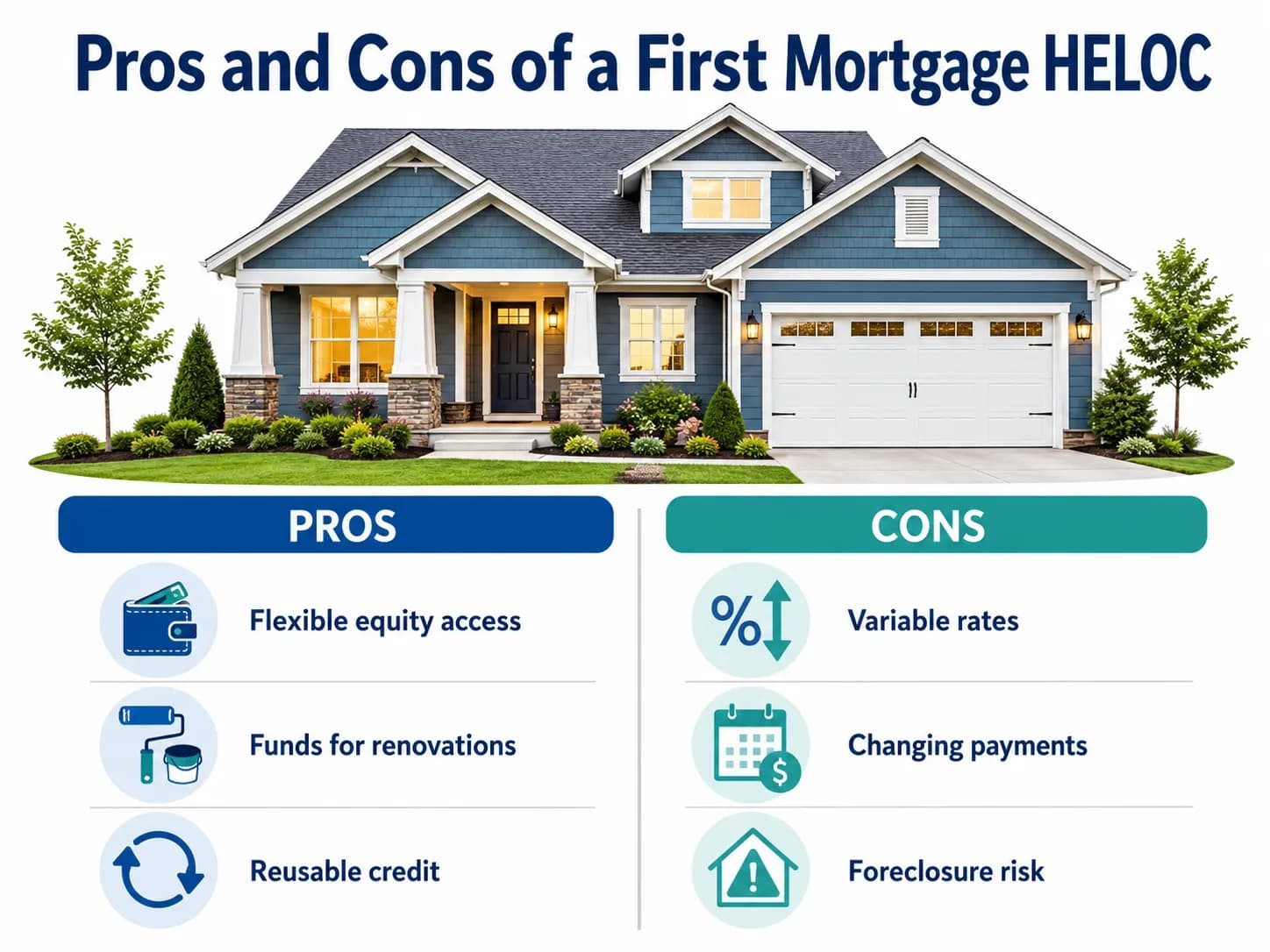
The Pros and Cons of a First Mortgage HELOC include flexible, reusable access to home equity and interest generally based on the outstanding balance. The main drawbacks are variable-rate and payment risk, possible fees, easier reborrowing, and the consequences of replacing an existing mortgage with debt secured by the home.
How Does a First Mortgage HELOC Work?
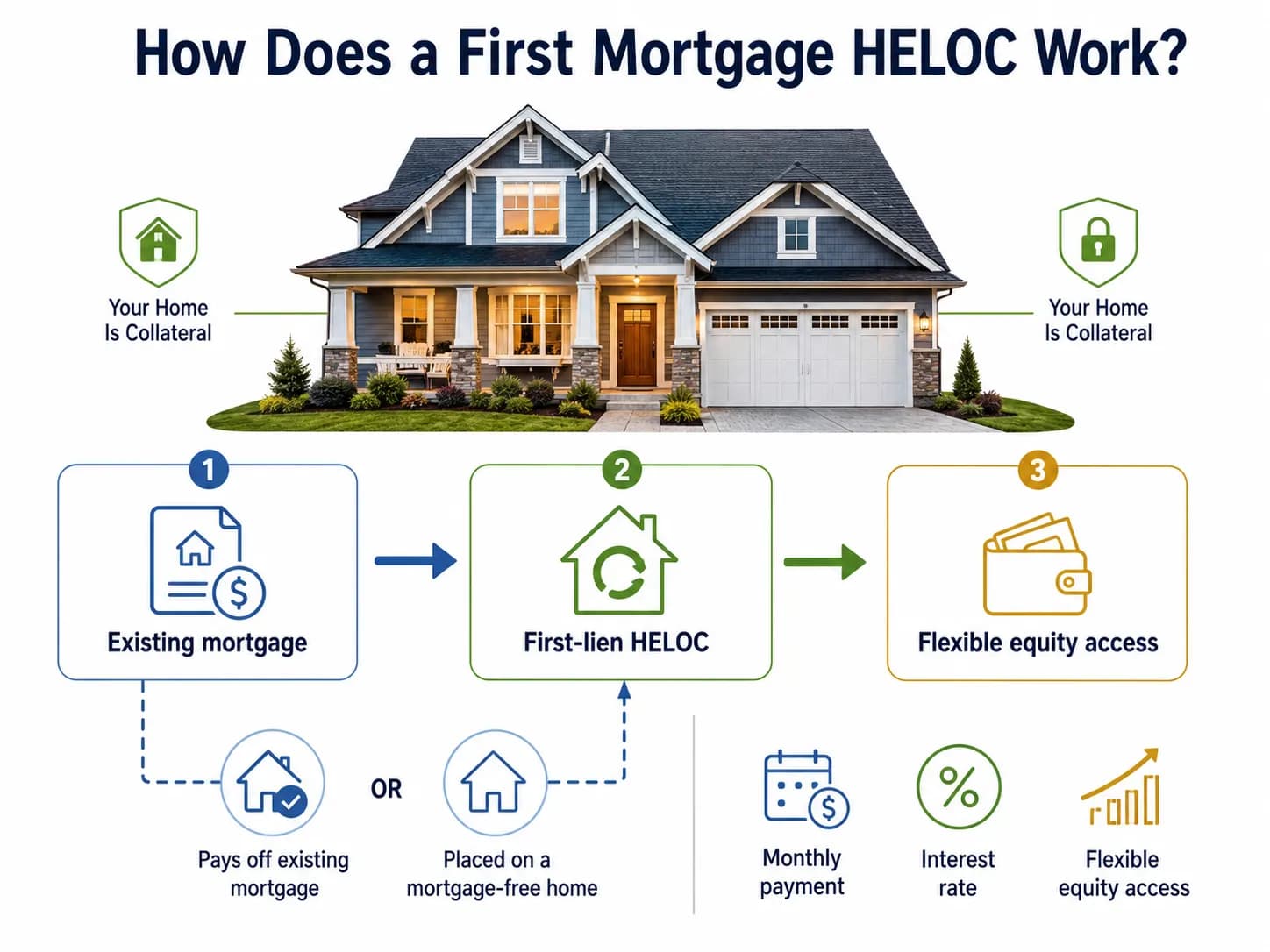
A First Mortgage HELOC is generally an open-end, revolving line of credit secured by a home in first-lien position. “First-lien” means the HELOC holds senior priority against the property. It may replace an existing first mortgage or become the first recorded mortgage on a property that is currently mortgage-free, depending on title, lender requirements, equity, and underwriting.
The homeowner receives an approved credit limit rather than one fixed principal amount. During the draw period, funds may be borrowed, repaid, and potentially used again under the agreement. The CFPB explanation of how a HELOC works describes this repeated borrowing as open-end credit.
Interest is generally calculated on the outstanding balance, but new draws raise that balance again. Repaid principal is not permanent payoff progress when it is later reborrowed.
Many products use an index plus a lender margin. Some may allow interest-only minimum payments for a period; others require principal and interest. The agreement controls the rate, draws, payments, maturity, fees, and fixed-rate options.
For a broader explanation of lien position, equity, draws, repayment, and borrower responsibilities, review the complete First Mortgage HELOC guide.
Before replacing an existing mortgage, it helps to compare the current balance, rate, remaining term, and payment structure with the proposed line. A transaction-specific review can reveal whether the added flexibility is worth the new risks and costs.
Review First Mortgage HELOC Options
What Are the Main Advantages of a First Mortgage HELOC?
The strongest potential benefit is flexibility. A homeowner may be able to draw funds only when needed, which can fit projects or expenses that occur over time. Interest is generally charged on the amount actually borrowed, so an unused portion of the credit limit normally does not create the same interest expense as an outstanding balance.
- Revolving access: Available credit may be reused after principal is repaid, when the agreement permits it.
- Staged borrowing: Homeowners can potentially fund renovations, education costs, or other approved needs in phases rather than taking one large advance.
- Balance-based interest: Interest is generally tied to the outstanding balance, not the full approved line.
- Payment flexibility: Some plans offer different payment or fixed-rate segment features, although availability and terms vary.
- One senior lien: When the HELOC replaces another mortgage, the homeowner may have one first-position account rather than separate first- and second-lien debts.
- Voluntary principal reduction: A borrower may be able to make payments above the required minimum, subject to account rules.
These benefits are conditional. Revolving credit may help manage uneven expenses, but it also makes repeated borrowing easier. A smaller required payment may improve short-term cash flow without reducing principal meaningfully.
Any savings depend on the existing mortgage, index, margin, fees, balance pattern, and repayment behavior. Replacing a favorable fixed-rate loan may create a very different result than replacing higher-cost debt.
What Are the Main Disadvantages and Risks of a First Mortgage HELOC?
The main disadvantage is uncertainty. Variable rates can change the cost of the same balance, while new draws can raise both the balance and payment.
- Variable-rate exposure: A higher contractual index may increase the rate and required payment.
- Promotional-rate expiration: An opening rate may apply only for a limited period.
- Limited principal reduction: Interest-only or low minimum payments may leave the principal balance largely unchanged.
- Repayment-period changes: Payments may increase when additional borrowing ends and principal repayment becomes more significant.
- Reborrowing risk: New draws can reverse earlier progress and extend the time the debt remains outstanding.
- Credit-line restrictions: Available credit may be reduced, frozen, or suspended under circumstances permitted by the agreement and applicable law.
- Fee exposure: Application, valuation, annual, transaction, conversion, and early-closure charges may affect total cost.
- Loss of a favorable mortgage: Paying off a low fixed-rate loan to create first-lien position may replace predictability with variable-rate debt.
- Foreclosure risk: The home secures the account, so serious payment default can place the property at risk.
The CFPB Home Equity Lines of Credit booklet recommends comparing draw rules, repayment terms, variable rates, fees, and early-termination provisions. Some plans may also require a balloon payment.
Federal Regulation Z requirements for home equity plans address disclosures and account provisions. Transaction-specific documents still control the borrower’s rate, payments, draw rights, and fees.
A First Mortgage HELOC may provide revolving access to home equity, but homeowners should compare variable rates, payments, fees, lien position, and alternatives.
How Can First Mortgage HELOC Rates and Payments Change?
Many First Mortgage HELOCs use a variable rate composed of a benchmark index plus a lender margin. The index is the outside reference named in the agreement, while the margin is the amount added under the lender’s pricing. Prime may be used as an index, but it is not automatically the borrower’s final rate.
Banks generally set their own prime rate. Homeowners can review the Federal Reserve explanation of the prime rate and Federal Reserve H.15 selected interest-rate data for benchmark context, not a personal quote.
Ask what formula applies after any promotional period. Review adjustment frequency, floors, caps, and whether a fixed-rate segment is available.
Payments may change for several reasons. The rate may adjust, the homeowner may borrow more, the minimum-payment formula may change, or the account may transition from the draw period to repayment. An interest-only payment covers accrued interest but does not reduce principal.
Test more than the opening payment. Compare the proposed rate, a higher-rate scenario, additional draws, and later repayment terms. The guide to First Mortgage HELOC rates and costs explains how the index, margin, floors, caps, and fees may interact.
How Does a First Mortgage HELOC Compare With Other Home Financing Options?
A First Mortgage HELOC is only one way to access home equity. The best comparison depends on whether the homeowner needs reusable credit, one lump sum, a fixed payment, or a complete replacement of the existing mortgage.
| Financing option | Credit structure | Typical rate structure | Access to funds | Payment predictability | Main potential benefit | Main risk or limitation |
|---|---|---|---|---|---|---|
| First Mortgage HELOC | Open-end revolving credit in first-lien position | Often variable; features vary | Draws may be available during the permitted period | Lower when rates, balances, or payment formulas change | Reusable access to equity | Rate, payment, reborrowing, and line-availability risk |
| Standard second-lien HELOC | Open-end revolving credit behind the first mortgage | Often variable | Draws may be available during the permitted period | Variable | May preserve the existing first mortgage | Creates an additional lien and separate payment |
| Home equity loan | Closed-end lump-sum loan | Often fixed, though products vary | Funds are generally disbursed once | Usually higher when the rate and payment are fixed | Predictable structure for a defined expense | No revolving redraw feature |
| Traditional mortgage | Closed-end installment financing | Fixed or adjustable | Defined principal at closing | Often stronger with a fixed-rate structure | Clear amortization and repayment schedule | Principal cannot normally be redrawn without new financing |
| Cash-out refinance | New closed-end mortgage replacing the current loan | Fixed or adjustable | Lump-sum cash at closing | Depends on the selected product | Combines the existing balance and cash-out amount | May replace favorable existing terms and involve closing costs |
The CFPB comparison of home equity loans and HELOCs distinguishes a lump-sum equity loan from a reusable line. The CFPB also outlines financing alternatives to a HELOC that homeowners may consider.
No option is automatically superior. A low fixed-rate mortgage may be worth preserving, while staged expenses may favor revolving access. Review the First Mortgage HELOC versus traditional mortgage comparison before focusing on one advertised payment.

When Might a First Mortgage HELOC Be Worth Considering?
A First Mortgage HELOC may deserve consideration when a homeowner has supported equity, stable qualifying income, a clear borrowing purpose, and a repayment plan that remains affordable if rates rise. It may fit expenses that occur in stages, such as a renovation with several contractor draws, better than a single lump-sum loan.
It may also appeal to a mortgage-free homeowner who wants a first-position line. Self-employed borrowers may value flexibility, but income documentation and higher-payment scenarios still require review.
Homeowners across Tulsa, Broken Arrow, Bixby, Jenks, Owasso, Coweta, Glenpool, Sapulpa, Sand Springs, Claremore, and nearby Oklahoma communities should ask whether they can avoid relying only on the minimum payment and unnecessary reborrowing.
A suitable borrower generally understands the difference between the credit limit and the balance and compares the ongoing rate rather than only an introductory offer. Approval and favorable terms are not guaranteed.
Reviewing the existing mortgage, estimated equity, proposed rate structure, fees, and alternatives can make the tradeoffs clearer before an application begins. The goal is to determine whether the product fits the homeowner’s actual plan, not to force every equity need into one structure.
Review First Mortgage HELOC Options
When Might a First Mortgage HELOC Be a Poor Fit?
A First Mortgage HELOC may be a poor fit for homeowners who need predictable payments or have little room for increases. It may also be unsuitable when replacing a low fixed-rate mortgage creates unwanted rate exposure.
Another option may fit better when the homeowner needs one known amount, expects to carry the debt for years, plans to make only minimum payments, or is likely to reborrow. Revolving flexibility has less value when certainty is the main goal.
Debt consolidation also requires care. Moving unsecured balances onto debt secured by the home changes the consequences of default and does not prevent new unsecured balances.
The product may be hard to justify when a sale is near, early-closure charges are high, income is unstable, or the borrower is uncomfortable using the home as collateral.
What Fees, Closing Costs, and Disclosures Should Homeowners Compare?
Interest is only one part of the cost. A First Mortgage HELOC may involve application, origination, appraisal, automated valuation, title search, title insurance, recording, annual, maintenance, inactivity, transaction, conversion, or early-closure charges. Not every lender charges every fee.
The CFPB guidance on HELOC fees explains that lenders may charge costs connected with the application, appraisal, title work, taxes, and account operation. Borrowers should request an itemized written fee schedule rather than relying on “no closing cost” language alone.
Waived upfront charges may have conditions, including reimbursement after early closure. Other offers may recover costs through pricing or annual charges.
HELOC disclosures differ from the Loan Estimate and Closing Disclosure used for many closed-end mortgages. Review the account-opening terms, variable-rate explanation, payments, draw limits, fees, and closure provisions.
Local support can be useful when title, first-lien placement, valuation, and existing mortgage payoff must be coordinated. Review the website’s local First Mortgage HELOC lender guidance for questions to ask when comparing providers.
What Qualification Factors Affect Approval and the Credit Limit?
Lenders generally evaluate the borrower, property, requested line, and existing secured debt together. Available equity matters, but equity alone does not guarantee approval or a particular credit limit.
- Supported property value and acceptable valuation method
- Existing mortgage balance and other recorded liens
- Loan-to-value and combined loan-to-value calculations
- Requested credit limit and anticipated initial draw
- Credit history, payment patterns, and current obligations
- Income stability and employment history
- Self-employment documentation when applicable
- Debt-to-income ratio and residual monthly capacity
- Assets and financial reserves
- Property type, occupancy, title condition, and first-lien eligibility
- Lender overlays, product restrictions, and underwriting findings
Homeowners can review their credit reports through AnnualCreditReport.com before applying. Correcting inaccurate report information may help the review process, but no score by itself guarantees approval, pricing, or a line amount.
Self-employed applicants may need tax returns, profit-and-loss statements, and bank records. Salaried borrowers may need pay statements, W-2 forms, employment verification, and asset documents. Requirements vary.
The website’s detailed guide to First Mortgage HELOC requirements explains how equity, credit, income, property, title, and documentation may affect the application.
What First Mortgage HELOC Mistakes Should Homeowners Avoid?
The most common mistake is focusing on one attractive number. An introductory rate or minimum payment does not reveal the ongoing formula, fees, principal reduction, future draws, or repayment obligation.
- Comparing only the promotional rate
- Treating prime as the borrower’s final rate
- Ignoring the lender margin, floor, and adjustment frequency
- Assuming a rate cap prevents meaningful payment increases
- Assuming interest-only payments reduce principal
- Treating temporary balance reductions as permanent payoff progress
- Ignoring later withdrawals and their effect on the balance
- Replacing a favorable fixed mortgage without a side-by-side analysis
- Ignoring annual, transaction, conversion, and early-closure fees
- Treating unused credit as guaranteed emergency savings
- Consolidating debt without addressing future borrowing
- Assuming interest is automatically tax-deductible
- Ignoring the risk created by using the home as collateral
- Relying on a payoff calculator or mortgage-acceleration claim as a promise
What Is the Most Important Comparison to Make?
Compare the First Mortgage HELOC using the ongoing rate formula, margin, floor, caps, payment method, expected balance, fees, first-lien impact, future withdrawals, repayment plan, and long-term affordability—not the advertised starting payment alone.
How Might the Pros and Cons Look in Realistic Situations?
What Might a Homeowner With a Low Fixed Mortgage Compare?
Consider a hypothetical Tulsa homeowner with substantial equity and a favorable fixed-rate mortgage. A variable-rate First Mortgage HELOC may add flexibility but reduce rate and payment certainty.
Compare keeping the mortgage, adding a second-lien product, using a home equity loan, refinancing, or delaying the project before replacing favorable terms.
What Might a Mortgage-Free Homeowner Planning Renovations Compare?
A hypothetical mortgage-free Broken Arrow homeowner expects renovation bills in stages. A first-position HELOC may allow draws as invoices arrive without interest on unused credit.
A fixed home equity loan may fit better when the budget is known. Compare rate tolerance, fees, draw rules, repayment discipline, and the need for future credit.
What Might a Self-Employed Homeowner Need to Review?
A hypothetical self-employed homeowner may have strong equity but variable income. The lender may review tax returns, bank statements, profit-and-loss information, debts, reserves, property value, and title.
The borrower should test affordability during slower months. Equity does not replace income, credit, or underwriting requirements.
What Should Oklahoma Homeowners Review Before Applying?
Use the same information to compare offers. Gather mortgage details, intended use, income records, and property information before focusing on an opening rate.
- Current mortgage balance, rate, remaining term, payment, and payoff statement
- Estimated property value, available equity, LTV, and CLTV
- Existing liens and first-position requirements
- Requested credit limit and expected initial draw
- Purpose, timing, and estimated duration of borrowing
- Credit history, mortgage payment history, income, employment, debts, assets, and reserves
- Index, margin, introductory period, ongoing formula, floor, and caps
- Draw-period and repayment-period payment calculations
- Whether minimum payments reduce principal
- Annual, transaction, conversion, valuation, title, and early-closure fees
- Conditions that may reduce or suspend further draws
- Payment scenarios using a higher rate or larger balance
- Standard HELOC, home equity loan, traditional mortgage, and cash-out refinance alternatives
- Long-term affordability and a plan for permanent principal reduction
For additional educational answers, visit the HELOC FAQ library for Oklahoma homeowners. You can also review Jeff Leek’s Oklahoma mortgage guidance for local information about HELOC, purchase, and refinance options.
Homeowners should not assume HELOC interest is deductible. Review IRS Publication 936 mortgage-interest guidance and speak with a qualified tax professional about the use of proceeds, documentation, and current tax rules.
A mortgage professional can compare the proposed line with the existing mortgage and alternatives, clarifying lien position, rate risk, payments, fees, and qualification without promising approval or savings.
Review First Mortgage HELOC Options
What Should Readers Verify Before Relying on This Guide?
This content is general mortgage education, not a loan offer, lending commitment, approval decision, or legal, tax, investment, or financial advice.
A First Mortgage HELOC does not guarantee approval, credit limits, fixed rates, lower payments, savings, faster payoff, continued access, or tax deductibility. Results depend on the lender, borrower, property, equity, title, market, agreement, behavior, and underwriting.
Rates, indexes, lender margins, fees, disclosures, product features, and qualification requirements can change. Homeowners should review current written documents and compare alternatives before replacing an existing mortgage or pledging the home for additional credit.
Reviewed by: Jeff Leek
Reviewer NMLS: 303051
Company: Geneva Financial, LLC., NMLS 42056
Last reviewed: June 24, 2026
What Questions Do Homeowners Ask About the Pros and Cons of a First Mortgage HELOC?
What Is a First Mortgage HELOC?
A First Mortgage HELOC is generally an open-end, revolving line of credit secured in first-lien position. It may replace an existing mortgage or become the first lien on a mortgage-free property, subject to lender, title, equity, property, and underwriting requirements.
What Are the Biggest Benefits of a First Mortgage HELOC?
Potential benefits include flexible access to equity, borrowing in stages, interest generally based on the outstanding balance, and the possible reuse of repaid credit. Every feature depends on the written account terms.
What Are the Biggest Risks of a First Mortgage HELOC?
The main risks include variable rates, changing payments, limited principal reduction, repeated borrowing, fees, possible restrictions on future draws, and foreclosure risk because the home secures the debt.
Can a First Mortgage HELOC Replace My Existing Mortgage?
It may replace an existing first mortgage when the new HELOC must obtain senior lien position. Availability depends on the lender, payoff, equity, title, property, requested line, and underwriting.
Are First Mortgage HELOC Rates Fixed or Variable?
Many use variable rates based on an index plus a margin. Some lenders may offer an introductory rate or allow part of the balance to be converted to a fixed-rate segment, but terms vary.
Can My First Mortgage HELOC Payment Increase?
Yes. Payments may rise when the rate changes, the borrower draws more funds, a promotional period ends, or the account moves from the draw period into repayment.
Is a First Mortgage HELOC Better Than a Home Equity Loan?
Neither is automatically better. A HELOC may fit staged borrowing, while a home equity loan may provide a more predictable lump-sum structure. Compare rates, fees, payment stability, access needs, and repayment goals.
Should I Speak With a Mortgage Professional Before Applying?
A review can help compare the current mortgage, supported equity, first-lien impact, variable-rate exposure, fees, qualification factors, payment scenarios, and alternatives before an application is submitted.