First Mortgage HELOC Rates and Costs You Need to Know
Many Tulsa homeowners see an advertised First Mortgage HELOC Rate and wonder whether it could replace their current mortgage, create flexible access to equity, or reduce borrowing costs. The headline rate alone does not answer those questions. A quoted rate may be introductory, variable, tied to an index, or available only to borrowers and properties that meet specific requirements.
This guide explains the index, lender margin, variable APR, rate adjustments, qualification, first-lien position, payment periods, fees, and payment risk.
Approval, available credit, interest rate, APR, payment, fees, first-lien eligibility, savings, and final terms are not guaranteed. Results depend on the lender, product, market conditions, borrower qualifications, property, title, lien position, and underwriting.
What Is a First Mortgage HELOC Rate?
A First Mortgage HELOC Rate is the interest rate charged on a revolving home equity line that holds first-lien position. Many products use a variable rate based on an index plus a lender margin. The final rate depends on the product, borrower qualifications, available equity, property details, title review, and underwriting.
How Does a First Mortgage HELOC Rate Work?
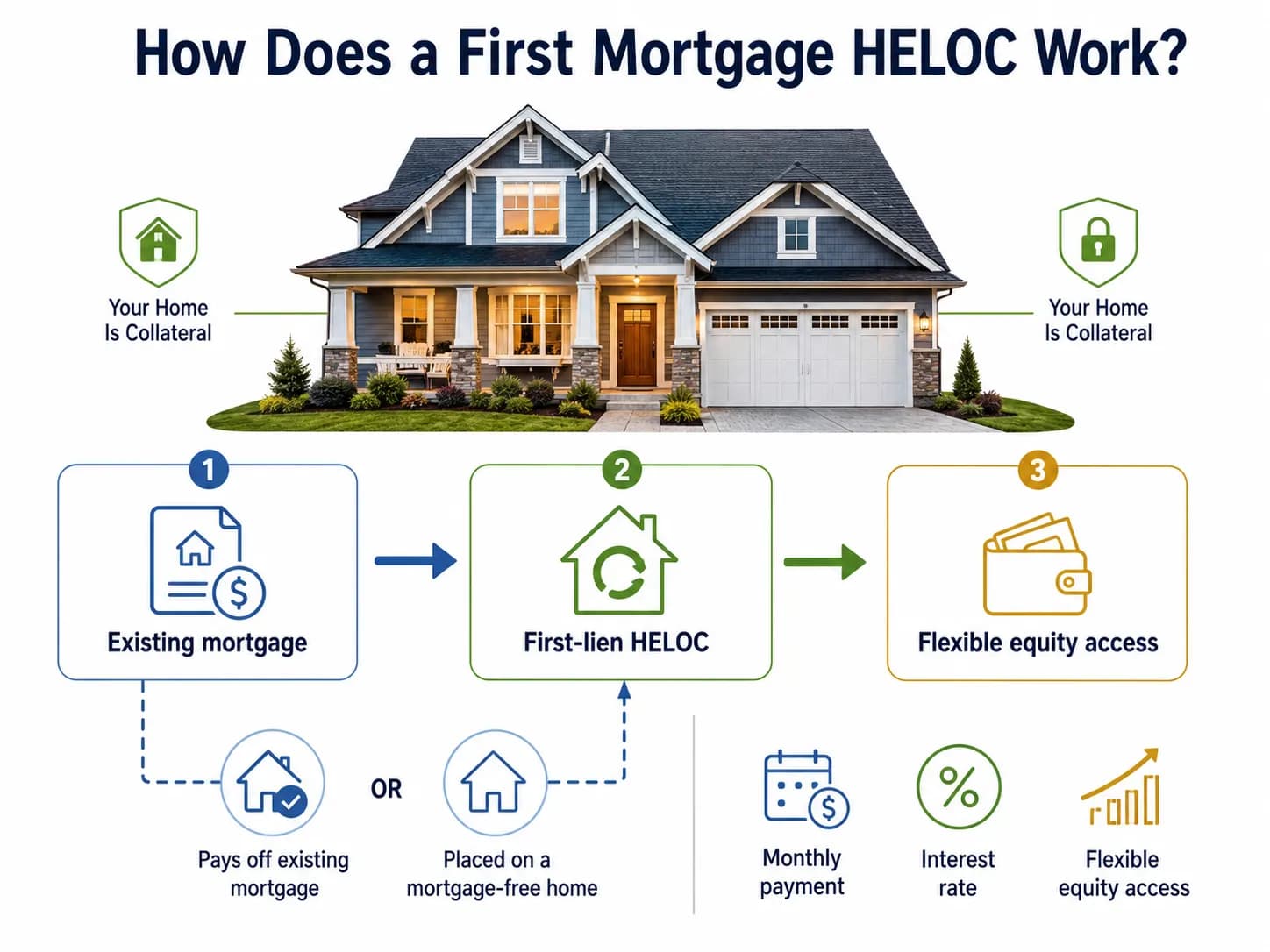
A First Mortgage HELOC is an open-end line of credit secured by a home and positioned as the senior lien. During the permitted draw period, a qualified homeowner may borrow, repay, and reuse available credit according to the account terms.
Interest is generally charged on the outstanding balance rather than the entire approved credit limit. The CFPB explanation of HELOCs and home equity loans describes a HELOC as reusable credit secured by home equity and notes that HELOC payments may vary with the balance and adjustable rate.
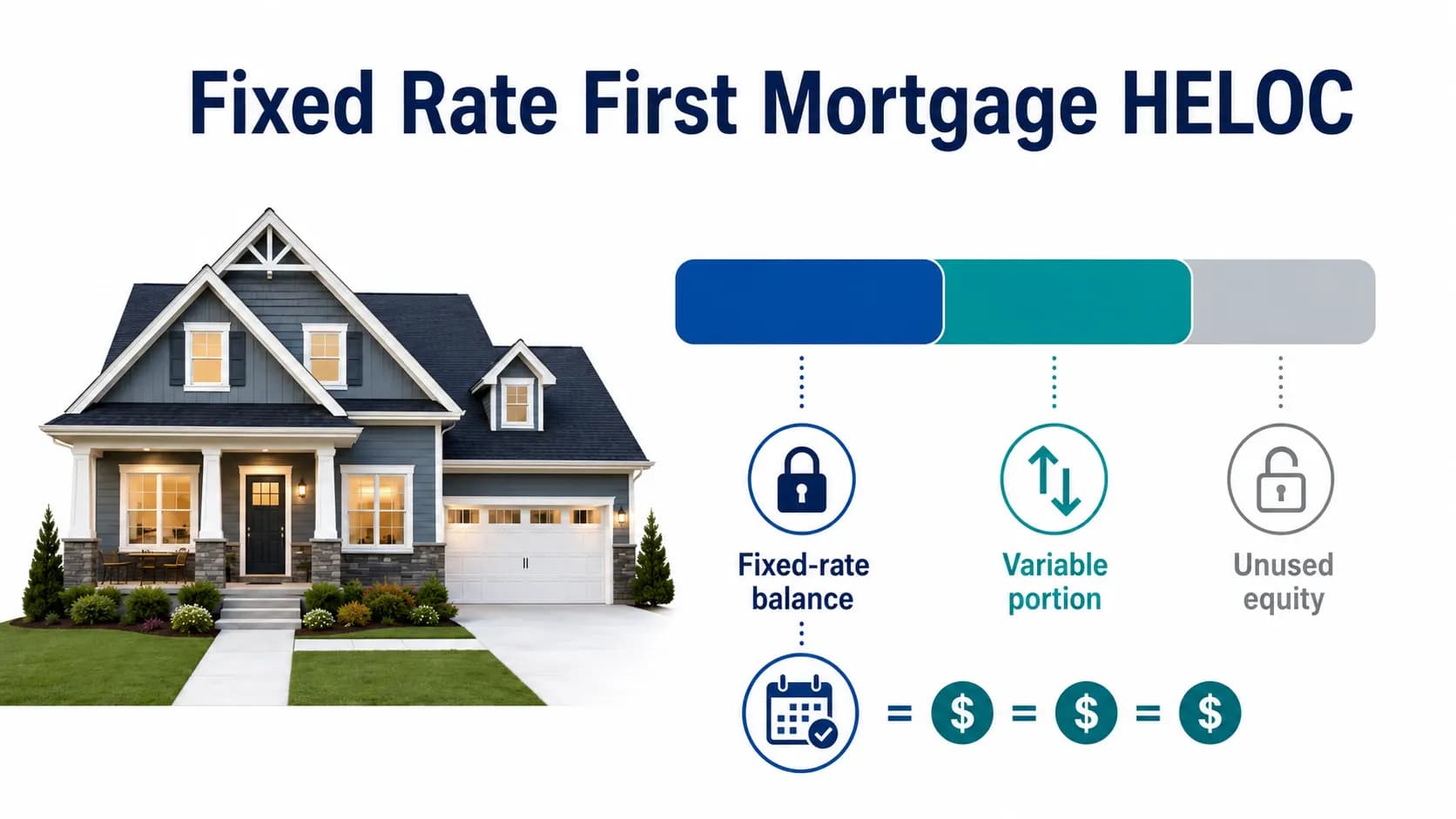
Many first-lien HELOCs use variable pricing. The contractual rate may move when the selected index changes, while the lender’s margin is added according to the agreement. A promotional starting rate may expire, and a homeowner’s payment can change when the rate or balance changes.
Homeowners in Tulsa, Broken Arrow, Bixby, Jenks, Owasso, Sand Springs, Claremore, Glenpool, Sapulpa, Coweta, Wagoner, Collinsville, Skiatook, and nearby communities should compare the full account structure. The website’s First Mortgage HELOC guide provides more context about equity, lien position, repayment periods, fees, and borrowing risks.
A file-specific review can clarify whether the quoted rate is introductory or ongoing, whether an existing mortgage must be paid off, and how the product compares with other financing. That review should support an informed decision rather than create an expectation of approval or savings.
Review First Mortgage HELOC Rate Options
How Is a First Mortgage HELOC Rate Calculated?
A variable HELOC rate commonly has two parts: an index and a margin. The index is an external benchmark identified in the account agreement. The margin is an additional percentage set by the lender or product terms.
In simple terms, the fully indexed rate may be calculated by adding the contractual margin to the applicable index. The agreement should explain which index is used, how its value is determined, when changes take effect, how often adjustments may occur, and whether a cap or floor applies.
The prime rate may serve as an index for some HELOC products, but it is not automatically the borrower’s final rate. Homeowners can review the Federal Reserve’s selected interest-rate data and the Federal Reserve Bank of St. Louis bank prime loan rate series to understand benchmark movements. Neither source is a personal loan quote.
An introductory rate may be lower than the rate that applies after the promotional period. Homeowners should ask for the ongoing formula, not only the opening rate, and should confirm whether the lender can change the margin or other terms under the agreement and applicable law.
This article does not quote a numerical “current” First Mortgage HELOC Rate because market benchmarks and lender pricing can change. Any rate used in advertising or comparison should include an exact verification date, assumptions, qualification language, and required disclosures.
What Factors May Affect a First Mortgage HELOC Rate?
Lenders may evaluate the entire risk profile rather than one isolated factor. Credit history, mortgage payment history, income stability, debt obligations, property value, requested line amount, lien position, occupancy, and underwriting findings may all influence approval and pricing.
Homeowners can review reports through AnnualCreditReport.com before applying. Reviewing a report can help identify inaccurate information or unresolved accounts, but a particular score does not guarantee approval or a specific rate.
Self-employed homeowners may be asked for tax returns, business bank statements, personal bank statements, and profit-and-loss statements. Salaried borrowers may need pay stubs, W-2 forms, employment verification, and asset documentation. Requirements vary by lender and file.
Homeowners who want a more detailed qualification overview can review the website’s First Mortgage HELOC requirements guide.
The HELOC FAQ library for Oklahoma homeowners also covers common questions about equity, rates, draw periods, repayment, and documentation.
| Rate factor | What it means | Why it may matter |
|---|---|---|
| Benchmark index | The external reference named in the agreement | Movement in the index may change a variable rate |
| Lender margin | The amount added to the index | Different margins can produce different borrower rates |
| Introductory rate | A temporary promotional rate | The payment may change when the introductory period ends |
| Rate cap and floor | Contractual maximums or minimums | They shape how far the rate may move |
| Credit profile | Payment history, utilization, and other credit factors | It may influence eligibility and pricing |
| CLTV | Total secured debt compared with property value | Higher leverage may reduce available credit or affect terms |
| First-lien position | The HELOC holds senior priority on title | Existing liens may need to be paid or restructured |
| Fees | Charges beyond interest | They can change the effective borrowing cost |
| Draw and repayment terms | How borrowing and repayment are scheduled | They influence payment timing and long-term affordability |
| Best next step | Review the complete written offer | Compare pricing, risk, fees, and alternatives together |
Can a First Mortgage HELOC Rate Change Over Time?
Yes, a variable First Mortgage HELOC Rate may rise or fall when the contractual index changes. The margin may remain fixed while the index moves, but the agreement controls the actual calculation and adjustment method.
Homeowners should review adjustment frequency, periodic limitations, the lifetime maximum, and the rate floor. A cap does not make variable-rate borrowing risk-free.
Promotional rates may expire. Even when the balance does not change, a higher variable rate may increase the required payment. If both the rate and balance rise, the effect can be greater.
Federal Regulation Z requirements for home equity plans address disclosures and limitations that may apply to HELOCs. Homeowners should still rely on their own account agreement and lender disclosures for transaction-specific terms.
Some products may allow part of the balance to be converted to a fixed-rate segment. Availability, pricing, minimum amounts, conversion fees, and repayment terms can vary, so the feature should not be assumed.
What Is the Difference Between Interest Rate and APR?
The interest rate generally describes the percentage used to calculate interest on the outstanding balance. APR is a disclosure measure, but the way it is presented for open-end credit differs from the disclosures used for a standard closed-end mortgage.
A homeowner should not assume a HELOC will use the same Loan Estimate and Closing Disclosure process as a traditional purchase mortgage or refinance. HELOC applicants typically receive product-specific disclosures that explain the APR, variable-rate structure, payment terms, fees, transaction rules, and other conditions.
The federal rules for open-end account disclosures provide regulatory context. The lender’s account-opening documents remain the practical source for the homeowner’s actual terms.
A lower advertised interest rate may not produce the lowest total cost when the offer has higher fees, a short promotional period, a restrictive floor, or payment terms that do not match the homeowner’s repayment plan.
How Do First-Lien Position and Existing Mortgages Affect the Rate?
A First Mortgage HELOC generally needs to hold senior lien position. If another mortgage is already recorded as the first lien, it may need to be paid off, replaced, or otherwise addressed before the HELOC can become the first mortgage.
The lender may review payoff statements, title, property value, secured debt, and CLTV. These factors may affect credit availability, pricing, closing, and approval.
First-lien status does not guarantee a lower rate. It also does not prove that replacing a favorable fixed-rate mortgage is financially beneficial. Homeowners should compare the new variable-rate structure against keeping the current mortgage and using a second-lien HELOC, fixed home equity loan, or another financing option.
Optional image: Clean visual showing a home, a variable-rate gauge, and index-plus-margin pricing.
First Mortgage HELOC rates may depend on an index, lender margin, borrower qualifications, available equity, property details, and product terms.
A mortgage professional can help identify whether first-lien placement would require paying off the existing mortgage and can compare that change with other available structures. The goal is to understand the complete debt position, not simply replace one payment with another.
Review First Mortgage HELOC Rate Options
How Do Draw-Period and Repayment-Period Payments Work?
The draw period is the phase when the homeowner may access available credit, subject to the agreement. Some products allow minimum payments based mainly on accrued interest, while others require principal and interest.
An interest-only payment does not reduce principal. If the homeowner continues drawing funds, the balance may remain high or increase even when every required payment is made.
When the repayment period begins, additional borrowing may stop and principal repayment may become more substantial. The required payment can increase because the borrower is paying down principal, the variable rate has changed, or both.
The CFPB’s HELOC guidance explains that payment arrangements can vary and that borrowers should prepare for the transition from borrowing to repayment. The website’s broader mortgage FAQ library also provides educational answers about HELOCs, VA loans, Section 184 loans, and other Oklahoma mortgage topics.
- Required minimum payment: The smallest payment permitted by the agreement for that billing cycle.
- Interest-only payment: A payment covering accrued interest without reducing principal.
- Principal payment: The portion that permanently reduces the balance unless funds are borrowed again.
- Voluntary extra payment: An amount paid above the minimum, subject to account terms.
- New draw: A later withdrawal that increases the outstanding balance.
Depositing income into the account may temporarily lower the balance. Later withdrawals for regular expenses raise it again. Mortgage-acceleration results depend on the rate, fees, timing, spending, deposits, withdrawals, and permanent principal reduction; the account structure alone does not guarantee faster payoff.
What Fees Can Affect the Total Cost of a First Mortgage HELOC?
Possible charges may include application, origination, valuation, appraisal, title search, title insurance, recording, annual, maintenance, inactivity, transaction, early-closure, and fixed-rate conversion fees. Not every lender charges every fee.
The official CFPB HELOC booklet encourages consumers to compare the index, margin, adjustment frequency, caps, floors, draw period, repayment period, upfront charges, annual fees, transaction fees, and early-termination terms.
A “no closing cost” offer may still contain conditions. The lender may use different pricing, require the line to remain open for a stated period, or require reimbursement of waived charges after an early closure.
Homeowners should request a written fee schedule and ask which charges apply at opening, while the account is active, when a fixed-rate conversion is used, and when the line is closed.
How Should Homeowners Compare First Mortgage HELOC Rate Offers?
Compare the ongoing rate formula, not only the promotional headline. Ask each lender for the index, margin, current fully indexed rate, introductory period, adjustment frequency, floor, cap, credit limit, payment method, draw period, repayment period, and complete fee schedule.
The CFPB’s mortgage rate exploration tool can help consumers understand that mortgage pricing depends on loan and borrower characteristics. It is not a First Mortgage HELOC quote, so product-specific offers and disclosures still need separate review.
Common mistakes include comparing only the starting rate, treating prime as the final borrower rate, ignoring the margin or floor, assuming interest-only payments reduce principal, and failing to model later payment changes.
Homeowners should also avoid assuming that HELOC interest is always deductible. The current IRS Publication 936 explains federal home-mortgage-interest rules, but tax treatment depends on the use of proceeds, applicable law, documentation, and individual circumstances. A qualified tax professional should provide tax advice.
Helpful insight: Compare a First Mortgage HELOC using the post-promotional rate, index, margin, caps, floors, fees, lien position, payment structure, expected balance, repayment behavior, and long-term affordability—not the advertised starting rate alone.
Additional Oklahoma mortgage and home-equity articles can help homeowners organize their questions before comparing written lender offers.
How Might First Mortgage HELOC Rates Work in Real-Life Situations?
What Might a Homeowner With a Low Fixed Mortgage Compare?
Consider a hypothetical Tulsa homeowner with substantial equity and an existing fixed-rate mortgage. Replacing that mortgage with a variable-rate first-lien HELOC could change the rate risk, payment structure, fees, and repayment timeline.
The homeowner should compare keeping the fixed mortgage, adding a second-lien product, completing a cash-out refinance, or using another source of funds. An eligible Veteran with an existing VA-backed mortgage may also review educational information about a VA IRRRL refinance, although eligibility, benefit requirements, costs, lender review, and final terms still apply.
What Might a Self-Employed Homeowner Need to Document?
A hypothetical self-employed homeowner may have strong equity but variable business income. The lender may review tax returns, business and personal bank statements, profit-and-loss statements, debts, credit, property value, CLTV, and income stability.
Equity can support the collateral position, but it does not replace the lender’s ability-to-repay and underwriting review. The approved rate and credit line remain file-specific.
What Might a Mortgage-Acceleration Strategy Require?
A hypothetical homeowner may deposit income into a First Mortgage HELOC and pay routine expenses from the line. The lower balance can reduce interest while the deposited funds remain in the account, but withdrawals raise the balance again.
The result depends on permanent principal reduction, variable-rate changes, account fees, deposit timing, withdrawal timing, spending discipline, and future draws. No exact savings, payoff date, rate, or payment outcome should be assumed.
What Should Homeowners Review Before Applying?
Preparation helps homeowners compare offers using the same facts. Gather current mortgage statements, payoff information, property-value estimates, income and asset documents, debt information, title details, and a clear plan for how much credit may actually be used.
- Current mortgage balance, rate, remaining term, and payoff information
- Estimated property value, available equity, LTV, and CLTV
- First-lien and title requirements
- Credit reports, mortgage history, and current obligations
- Income, employment, self-employment, and reserve documentation
- Requested line amount and expected initial draw
- Index, margin, introductory rate, and post-promotional formula
- Adjustment frequency, floor, periodic cap, and lifetime cap
- Draw-period and repayment-period payment methods
- Annual, transaction, valuation, title, recording, and early-closure fees
- Higher-rate payment scenarios and long-term affordability
- Traditional mortgage, refinance, second-lien HELOC, and home equity loan alternatives
The CFPB’s mortgage consumer resources can support broader loan shopping and document review. Homeowners can also use Jeff Leek’s Oklahoma loan comparison calculator to organize educational scenarios before requesting personalized terms.
A mortgage professional can help compare the index, margin, variable-rate risk, fees, first-lien structure, and alternatives using the homeowner’s actual balance, property, and goals. The review cannot guarantee approval or pricing, but it can make the tradeoffs easier to see.
Review First Mortgage HELOC Rate Options
What Questions Do Homeowners Ask About First Mortgage HELOC Rates?
What Is a First Mortgage HELOC Rate?
It is the interest rate charged on a revolving home equity line that holds first-lien position. The rate may be variable and based on an index plus a lender margin.
Are First Mortgage HELOC Rates Fixed or Variable?
Many are variable, but product structures differ. Some lenders may offer a temporary introductory rate or an option to convert part of the balance to a fixed-rate segment.
How Is a First Mortgage HELOC Rate Calculated?
The agreement may add a lender margin to a specified index. Credit, equity, CLTV, property, lien position, line amount, and underwriting may also influence the offered terms.
Is the Prime Rate the Same as My HELOC Rate?
No. Prime may serve as the contractual index, but the lender may add a margin. The borrower’s final rate can therefore differ from the published prime rate.
Can a First Mortgage HELOC Rate Increase?
Yes. A variable rate may increase when the index changes, subject to the account terms, floor, caps, and applicable rules. A promotional rate may also expire.
Does a Lower HELOC Rate Guarantee Lower Borrowing Costs?
No. Fees, promotional periods, balance behavior, withdrawals, repayment terms, rate changes, and the cost of replacing an existing mortgage can affect the total cost.
Can a First Mortgage HELOC Replace My Current Mortgage?
It may in some transactions because the HELOC must generally obtain first-lien position. Whether the existing mortgage must be paid off depends on title, lender requirements, property value, and underwriting.
Should I Compare a First Mortgage HELOC With a Cash-Out Refinance?
Yes. Compare rate stability, fees, available funds, payment structure, lien position, existing mortgage terms, expected borrowing behavior, and long-term affordability.
What Should Readers Verify Before Relying on This Guide?
This content is for general mortgage education. It is not a rate quote, commitment to lend, approval decision, legal opinion, financial plan, or tax recommendation.
A First Mortgage HELOC does not guarantee approval, available credit, lower payments, faster payoff, savings, tax deductibility, or specific terms. Results depend on the lender, product, index, margin, borrower profile, property, lien position, market conditions, and underwriting.
Rates, benchmark indexes, lender margins, fees, disclosures, and program requirements may change. Homeowners should review current written account terms and compare alternatives before making a decision.
Reviewed by: Jeff Leek
Reviewer NMLS: 303051
Last reviewed: June 23, 2026