First Mortgage HELOC Guide | Compare Your Rates and Options
A homeowner may want to access equity for renovations, consolidate debt, prepare for irregular expenses, or create a flexible source of funds. A First Mortgage HELOC may be one option, but it works differently from a traditional fixed-rate mortgage, a home equity loan, or a HELOC recorded behind an existing mortgage.
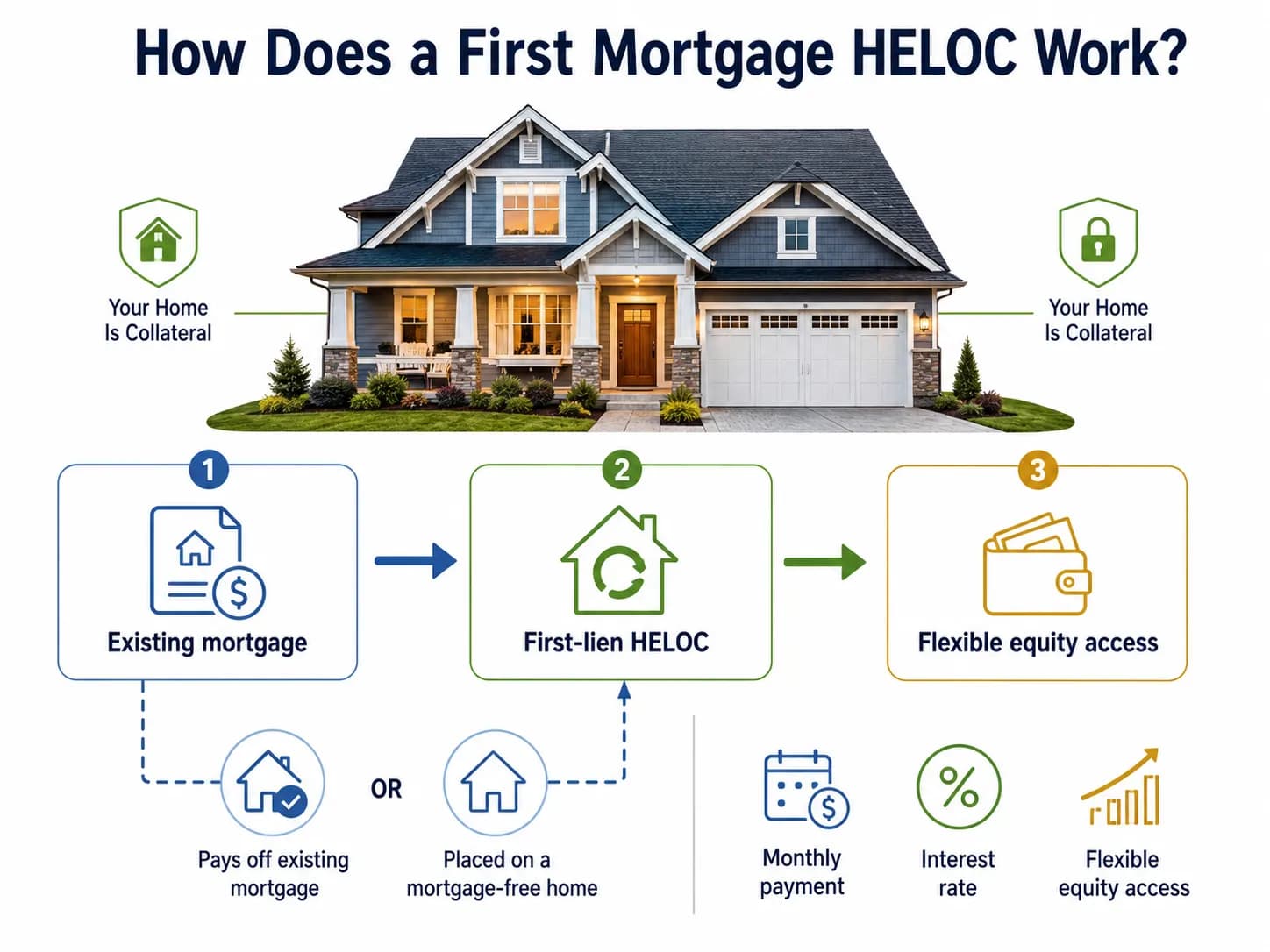
The words “first mortgage” refer to lien position. In some transactions, the HELOC pays off an existing mortgage and becomes the first lien against the property. In other situations, it may be placed on a home that does not currently have another mortgage.
That structure can provide flexibility, but it can also introduce variable rates, changing payments, account fees, borrowing restrictions, and additional risk. Because the home secures the line, homeowners should understand the complete agreement before replacing an existing mortgage or drawing funds.
This guide explains how a first-lien HELOC may work, how homeowners may qualify, what costs and risks to review, and how it compares with other home-equity and refinance options. Homeowners can also review Jeff Leek’s Oklahoma mortgage guidance for additional local information.

What Is a First Mortgage HELOC?
A First Mortgage HELOC is generally an open-end, revolving home equity line of credit secured in the first-lien position. It may replace an existing mortgage or become the primary lien on a mortgage-free property. Qualification, credit limits, rates, payments, fees, borrowing access, and repayment terms depend on the lender, borrower, property, and program.
A First Mortgage HELOC should be reviewed based on its lien position, variable-rate structure, payment terms, costs, and long-term risks.
How Does a First Mortgage HELOC Work?
A First Mortgage HELOC is usually structured as open-end credit. Instead of receiving one fixed loan amount that is fully disbursed at closing, the homeowner receives an approved credit limit.
During the permitted borrowing period, commonly called the draw period, the borrower may access funds up to the available limit. When principal is repaid, some products may allow that amount to become available again, subject to the credit agreement and any lender restrictions.
Interest is generally calculated on the outstanding balance rather than the full approved credit limit. The CFPB’s explanation of home equity lines of credit describes a HELOC as an open-end line that allows repeated borrowing against available home equity.
The defining feature of a First Mortgage HELOC is its lien position. If the homeowner already has a mortgage, that loan may need to be paid off so the new HELOC can be recorded in first position. If the home is owned without a mortgage, the HELOC may become the first recorded lien without replacing another loan.
First position affects priority, not safety. The borrower’s home remains collateral for the debt. Missed payments may lead to default, collection activity, and foreclosure, depending on the circumstances and applicable law.
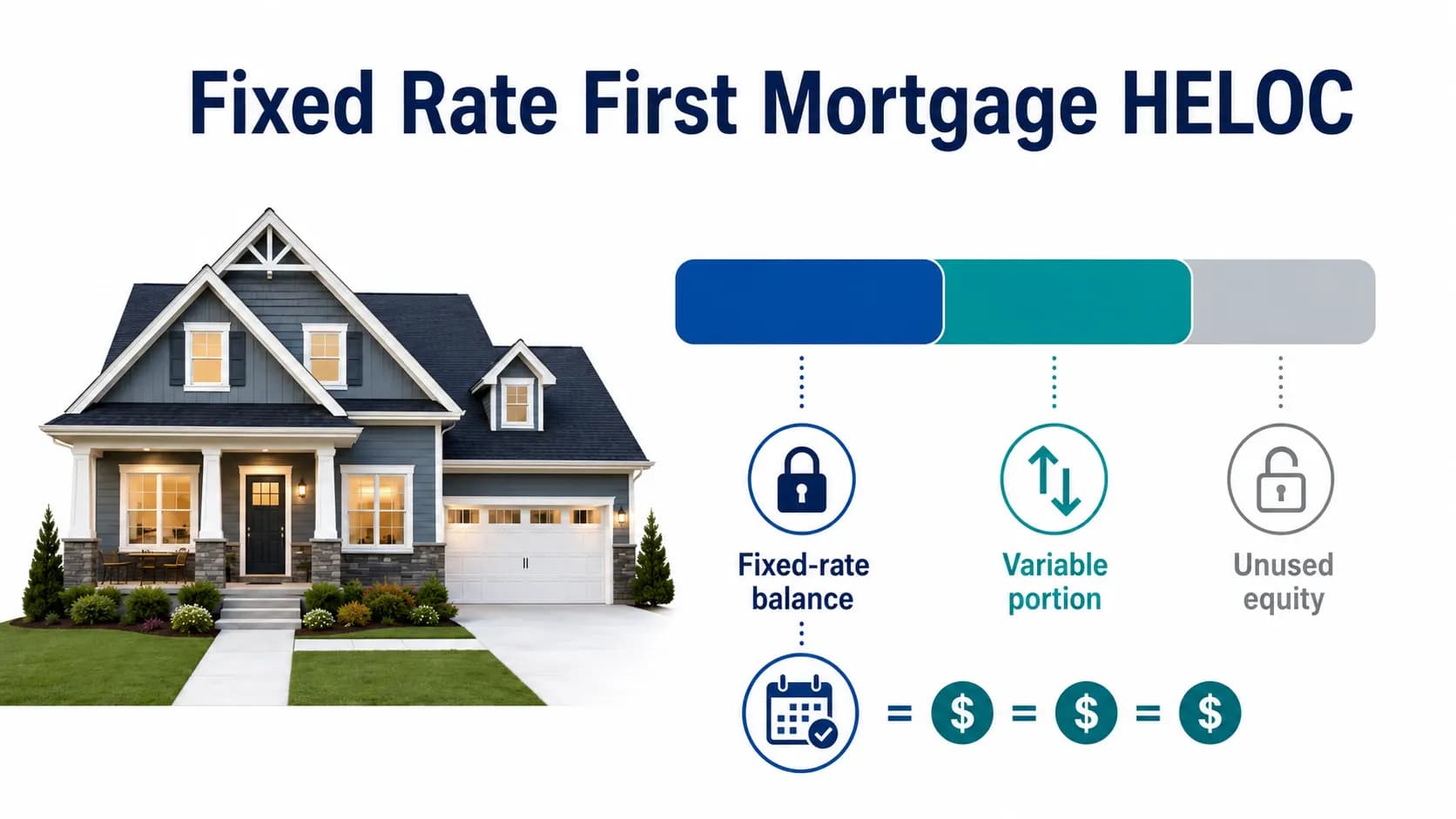
Rates are commonly variable, meaning the borrowing cost and monthly payment may change over time. Some products may offer a fixed-rate conversion for part of the balance, but that feature is not universal.
The homeowner should review the lender’s payment formula, initial-draw requirements, minimum transaction amounts, annual fees, maturity date, repayment period, and circumstances under which access to the line may be reduced or suspended.
Additional answers about equity, rates, draw periods, and repayment are available in the website’s HELOC FAQ library for Oklahoma homeowners.
Replacing a mortgage can affect payment stability and total borrowing cost. A homeowner should compare verified terms rather than relying only on the advertised rate or initial payment.
How Is a First Mortgage HELOC Different From a Standard HELOC?
A standard HELOC is often recorded behind an existing mortgage. In that arrangement, the original mortgage remains the first lien, and the HELOC becomes a junior lien or second mortgage.
A First Mortgage HELOC occupies the first-lien position. This may happen because the new credit line pays off the existing mortgage or because no other mortgage is recorded ahead of it.
The CFPB’s explanation of a second mortgage or junior lien helps explain why the order of the liens matters. Lien priority can affect a future sale, refinance, foreclosure, or request to subordinate one loan behind another.
A traditional mortgage is generally closed-end credit. The borrower receives a defined amount and repays it over an established schedule. A HELOC is generally open-end credit, allowing repeated borrowing during the draw period when the agreement permits it.
A home equity loan is also different. It commonly provides one lump sum and a defined repayment schedule. The CFPB comparison of home equity loans and HELOCs explains the basic difference between lump-sum borrowing and revolving access.
These distinctions affect payment predictability, interest-rate risk, closing costs, access to future funds, and long-term affordability. Homeowners should compare the available Oklahoma mortgage and home-equity options before choosing a structure.
What Determines Whether a Homeowner May Qualify?
Home equity is an important qualification factor, but it is not the only one. A lender may review the homeowner’s credit history, income, employment, monthly obligations, assets, reserves, property value, occupancy, title, and existing liens.
The lender may also consider the requested credit limit and the amount the homeowner plans to draw initially. A larger line or initial balance can affect the loan-to-value calculation and the lender’s risk assessment.
Loan-to-value ratio, or LTV, compares the secured debt with the supported property value. Combined loan-to-value ratio, or CLTV, considers all liens that will remain against the property.
If the First Mortgage HELOC pays off an existing mortgage, the lender may calculate the transaction using the new line, the expected initial balance, and any other liens that remain after closing.
| Applicant Type | Common Documentation | Important Note |
|---|---|---|
| Veteran | DD Form 214 or other separation records | VA may request more information if records are incomplete. |
| Active duty | Current signed statement of service | The statement should contain the details required by current VA guidance. |
| National Guard or Reserve | NGB forms, points statement, or proof of honorable service | Requirements depend on status and activation history. |
| Eligible surviving spouse | Applicable VA form, separation records, and supporting relationship or death records |
| First Mortgage HELOC factor | What it means | Why it matters |
|---|---|---|
| Lien position | The order of recorded claims against the property | The existing mortgage may need to be paid off |
| Property value | The supported value used by the lender | It affects available equity and the potential credit limit |
| LTV or CLTV | Secured debt compared with property value | Program limits may restrict the available line |
| Credit profile | Credit score, payment history, and current accounts | It may affect approval, pricing, and available credit |
| Income and employment | The borrower’s documented ability to repay | Income requirements can vary by lender and borrower type |
| Debt-to-income ratio | Monthly debt compared with qualifying income | Higher obligations may reduce borrowing capacity |
| Rate structure | Index, margin, adjustments, and possible rate caps | It determines how borrowing costs may change |
| Draw and repayment terms | When funds can be accessed and when principal is repaid | Payments may increase when the draw period ends |
| Fees | Upfront, annual, transaction, or early-closure costs | Fees affect the real cost of opening and maintaining the line |
Property type and occupancy may also matter. Requirements for a primary residence, second home, or investment property can differ. Title issues, tax liens, judgments, homeowners insurance, flood insurance, and HOA obligations may also affect the transaction.
The website’s educational loan comparison calculator may help homeowners organize possible scenarios. Calculator results are educational only and are not an approval, loan quote, or commitment to lend.
How Do the Draw and Repayment Periods Work?
The draw period is the phase when the borrower may access funds from the HELOC. The homeowner may be able to borrow, repay principal, and draw again, provided the account remains open and the agreement permits continued access.
Some lenders establish an initial-draw requirement or a minimum amount for later transactions. Funds may be accessed through a transfer, check, card, online request, or another method supported by the lender.
Payments during the draw period vary by product. Some may require interest-only payments, while others require a portion of principal. Interest-only payments can provide a lower initial payment, but they do not reduce the principal balance.
When the draw period ends, additional borrowing generally stops. The outstanding balance then enters repayment under the terms of the agreement.
Payments may increase when the borrower begins repaying both principal and interest. A homeowner who has become accustomed to interest-only payments may experience significant payment shock.
Some HELOCs fully amortize during the repayment period. Others may leave a balance due at maturity. Homeowners should review the CFPB’s HELOC consumer booklet and ask the lender whether a balloon payment could remain.
A renewal or extension is not guaranteed. Refinancing at the end of the draw period is also not guaranteed. The borrower’s income, credit, equity, property value, and market conditions may be different when the account approaches maturity.
How Can Variable Rates and Minimum Payments Affect the Cost?
Many HELOCs have variable interest rates. The rate is commonly calculated using an index plus a lender margin.
The index may move with market conditions. The margin is the amount the lender adds to the index under the credit agreement. If the index rises, the borrower’s rate and payment may rise.
Some offers include an introductory rate for a limited period. The homeowner should identify when that period ends and how the regular rate will be calculated afterward.
Rate caps may limit how much the rate can change at one time or over the life of the account, depending on the product. A cap does not mean the rate or payment will remain fixed.
The official Regulation Z requirements for home-equity plans address disclosures involving variable rates, minimum payments, fees, and other HELOC terms.
The minimum-payment formula is especially important. During the draw period, the required payment may cover only interest or a small amount of principal. Paying the minimum can leave a substantial balance when the repayment period begins.
A low initial payment does not necessarily mean the HELOC has a lower long-term cost than a fixed-rate mortgage, home equity loan, or cash-out refinance. A responsible comparison should consider possible rate increases, average balances, fees, and how quickly principal will be repaid.
What Costs and Fees May Apply?
First Mortgage HELOC fees vary by lender, property, location, credit profile, and account structure. Homeowners should request written information about both closing costs and ongoing charges.
Possible costs may include:
- Application or origination fees
- Credit-report fees
- Appraisal or automated valuation fees
- Title-search and title-insurance costs
- Settlement or attorney fees where applicable
- Recording charges
- Flood-determination charges
- Annual account fees
- Transaction or draw fees
- Inactivity fees
- Fixed-rate conversion fees
- Cancellation or early-closure fees
- Existing mortgage payoff costs
The CFPB’s HELOC fee guidance explains that fees may apply when the line is opened and while the account remains active.
An offer described as “no closing cost” does not always mean the transaction has no cost. The lender may pay certain expenses in exchange for different pricing, or the borrower may be required to reimburse costs if the line closes within a specified period.
If the HELOC replaces a current mortgage, the closing process may also involve a payoff statement, accrued interest, release documents, title review, and recording of the new lien.
Because a HELOC is generally open-end credit, its disclosures may differ from the Loan Estimate and Closing Disclosure commonly associated with closed-end mortgages. Homeowners should review the account-opening disclosures, variable-rate terms, payment examples, fee schedule, applicable rescission notice, and complete agreement.
The CFPB also provides guidance about situations in which proposed HELOC terms change before opening.
A detailed cost comparison can show whether the flexibility of a revolving line is worth the upfront costs, ongoing fees, and variable-rate exposure.

Can a First Mortgage HELOC Help Pay Off a Home Faster?
A homeowner may pay off secured debt faster by consistently making additional principal payments. That principle can apply to a HELOC and to many traditional mortgages.
The HELOC structure alone does not guarantee faster payoff or interest savings. Results depend on the interest rate, account fees, timing of deposits, timing of withdrawals, spending habits, and the amount of permanent principal reduction.
Some mortgage-acceleration strategies recommend depositing income into the HELOC and paying routine expenses from the line. A temporarily lower balance may reduce interest while the money remains in the account, but later withdrawals raise the balance again.
If the borrower repeatedly draws funds after making payments, the principal may decline slowly or increase. A rising variable rate can also reduce an expected advantage.
Interest-only minimum payments do not reduce principal. A homeowner who wants to pay down the balance faster generally needs to make payments above the required interest amount.
Terms such as velocity banking, sweep banking, all-in-one mortgage, checking-account mortgage, and mortgage acceleration may describe different products or financial strategies. They should not be treated as standard features of every First Mortgage HELOC.
A fair comparison should evaluate the proposed HELOC strategy against keeping the current mortgage and making additional principal payments. The homeowner should also consider emergency reserves, income stability, fees, rate risk, and the likelihood of borrowing the money again.
What Risks Should Oklahoma Homeowners Understand?
A HELOC is secured by the borrower’s home. If the borrower cannot make the required payments, the account may enter default and the property may face foreclosure.
The FTC’s consumer guidance on HELOCs and home equity loans emphasizes the importance of understanding the repayment obligation before using a home as collateral.
- Variable-rate risk: The rate and monthly payment may increase.
- Payment-shock risk: Payments may rise when the repayment period begins.
- Balloon-payment risk: A balance may remain due at maturity.
- Credit-access risk: The lender may be permitted to reduce or suspend the available line under certain conditions.
- Property-value risk: Falling home values may affect available credit and future refinancing options.
- Income risk: Job loss or reduced income may make a variable payment harder to manage.
- Debt-consolidation risk: Unsecured debts may become debts secured by the home.
- Re-borrowing risk: Continued draws may prevent meaningful debt reduction.
- Refinancing risk: A future refinance, renewal, or extension may not be available.
- Title risk: Existing liens or unresolved title issues may delay or prevent the transaction.
Replacing a low fixed-rate mortgage with a variable-rate line can also exchange payment predictability for flexibility. That decision should account for possible rate increases rather than relying only on the initial payment.
Homeowners looking for local mortgage guidance across Tulsa and Oklahoma should confirm that the desired product is available for their property, occupancy, and financial profile.
How Does a First Mortgage HELOC Compare With Other Options?
Second-lien HELOC: A second-lien HELOC leaves the existing first mortgage in place. This can help a homeowner preserve a favorable first-mortgage rate while adding revolving access to equity. The homeowner must manage two separate secured debts.
Home equity loan: A home equity loan usually provides a lump sum with a defined repayment schedule. It may offer more predictable payments than a variable-rate HELOC, but it normally does not allow repeated borrowing.
Cash-out refinance: A cash-out refinance replaces the existing mortgage with a new closed-end loan and provides cash from the homeowner’s equity. It may simplify repayment into one loan, but it reprices the entire mortgage balance.
Rate-and-term refinance: A rate-and-term refinance focuses primarily on changing the rate, term, or payment structure. It may be more appropriate when predictable repayment is more important than revolving access.
Fixed-rate mortgage: A fixed-rate mortgage generally provides stable principal-and-interest payments. Property taxes, insurance, and other escrow costs can still change, but the loan rate remains fixed.
Adjustable-rate mortgage: An adjustable-rate mortgage is generally closed-end credit with a rate that can change after an initial period. It does not operate like a revolving HELOC.
Personal loan: A personal loan is commonly unsecured. It may carry different rates and limits, but it does not place a mortgage lien against the property.
The CFPB’s guide to using home equity can help homeowners compare how borrowing purpose, repayment structure, and risk interact.
No option is automatically best. A homeowner with a low fixed mortgage rate may reach a different conclusion from someone with a higher-cost mortgage or no current mortgage at all.
What First Mortgage HELOC Mistakes Should Homeowners Avoid?
- Assuming every HELOC can be placed in first position
- Assuming the product is available from every lender
- Assuming home equity alone guarantees approval
- Comparing only the introductory interest rate
- Ignoring the lender margin and rate index
- Ignoring periodic or lifetime rate caps
- Assuming the payment will remain unchanged
- Assuming interest-only payments reduce principal
- Ignoring the end of the draw period
- Failing to review the repayment-period payment
- Ignoring maturity or balloon-payment language
- Assuming available credit can never be reduced
- Ignoring annual, inactivity, transaction, or early-closure fees
- Replacing a low fixed-rate mortgage without comparing long-term cost
- Converting unsecured debt into home-secured debt without reviewing the added risk
- Borrowing funds again after making principal progress
- Relying on a calculator without checking its assumptions
- Assuming all HELOC interest is tax deductible
- Using all available liquidity without keeping emergency reserves
- Signing before reviewing the full credit agreement
Helpful insight: Evaluate a First Mortgage HELOC based on its lien position, variable-rate formula, payment calculation, draw period, repayment obligations, fees, credit-access restrictions, long-term cost, and risk to the home. Flexibility and a low starting payment are only part of the decision.
What Could a First Mortgage HELOC Look Like for an Oklahoma Homeowner?
Could a Tulsa Homeowner Use One for Renovations?
A Tulsa homeowner planning a renovation in several phases may prefer access to a revolving line instead of receiving the entire project budget at closing. The borrower may draw funds as contractor invoices become due.
The homeowner would still need to compare the variable rate, draw fees, contractor schedule, cost-overrun risk, and repayment plan with a fixed-rate home equity loan or cash-out refinance.
Could a Self-Employed Homeowner Use One for Cash-Flow Flexibility?
A self-employed homeowner may value revolving access because income arrives at irregular times. Qualification may require tax returns, bank statements, business documentation, or other evidence of stable qualifying income.
The line should not become a permanent substitute for sustainable cash flow. Reserves, disciplined borrowing, and a realistic principal-repayment plan remain important.
Could a Broken Arrow Homeowner Replace an Existing Mortgage?
A Broken Arrow homeowner may consider using a first-lien HELOC to pay off the current mortgage. The comparison should include the current fixed rate, remaining term, payoff balance, closing costs, proposed HELOC margin, expected average balance, payment formula, and possible future rate increases.
The homeowner should also evaluate the value of predictable mortgage payments before replacing them with a revolving, variable-rate structure.
Homeowners can learn more about Jeff Leek’s local HELOC and mortgage experience when preparing questions for a personalized comparison. Product availability and final terms must be confirmed for the individual transaction.
What Should Homeowners Review Before Moving Forward?
A useful First Mortgage HELOC review begins with the current mortgage, property, household budget, and intended use of the funds.
Homeowners should gather or review:
- Estimated property value
- Current mortgage balance
- Current mortgage interest rate
- Remaining mortgage term
- Current principal-and-interest payment
- Mortgage payoff statement
- Information about additional liens
- Property taxes and homeowners insurance
- Flood-insurance requirements where applicable
- HOA dues or assessments
- Credit history and payment history
- Income and employment documentation
- Self-employment records where required
- Monthly debt obligations
- Assets and emergency reserves
- Requested credit limit
- Intended initial draw
- Planned use of the funds
- Rate index and lender margin
- Introductory-rate expiration
- Periodic and lifetime rate caps
- Minimum-payment formula
- Interest-only terms where applicable
- Draw-period length
- Repayment-period length
- Maturity date and balloon-payment risk
- Annual, transaction, inactivity, and early-closure fees
- Rules for reducing or suspending the credit line
- Plans to sell or refinance the property
- Alternative home-equity and refinance options
Tax treatment should also be reviewed carefully. HELOC interest is not automatically deductible. Deductibility may depend on current tax law, the use of the funds, applicable limitations, and the homeowner’s individual situation.
Homeowners can review IRS Publication 936 information and speak with a qualified tax professional before relying on a deduction.
Additional Oklahoma mortgage and home-equity articles can help homeowners prepare for a more informed loan conversation.
A First Mortgage HELOC can change both the lien against the property and the way monthly borrowing costs behave. Compare the complete terms with a second-lien HELOC, home equity loan, and refinance before choosing a direction.
What Questions Do Homeowners Ask About First Mortgage HELOCs?
What Is a First Mortgage HELOC?
It is generally an open-end home equity line of credit secured in the first-lien position. It may replace an existing mortgage or become the first mortgage on a property without another loan ahead of it.
Is a First Mortgage HELOC the Same as a Second Mortgage?
No. A second mortgage is recorded behind a first lien. A First Mortgage HELOC occupies the first-lien position, although both products are secured by the home.
Can a First Mortgage HELOC Replace My Current Mortgage?
It may replace a current mortgage when the transaction pays off or otherwise resolves the existing loan so the HELOC can be recorded in first position. Product availability and approval are not guaranteed.
Does a First Mortgage HELOC Have a Fixed Interest Rate?
Many HELOCs use variable rates. Some products may allow the borrower to convert part of the balance to a fixed rate, subject to lender terms, limits, and possible fees.
Can the Lender Reduce or Freeze My Available Credit?
In certain circumstances, applicable law and the account agreement may permit the lender to reduce or suspend access. Homeowners should understand those provisions before relying on the line for future expenses.
Can a First Mortgage HELOC Pay Off My Home Faster?
Faster payoff depends on actual principal payments, interest rates, fees, withdrawals, income, spending, and borrowing behavior. Depositing income into the account does not guarantee savings or a faster payoff.
Is First Mortgage HELOC Interest Tax Deductible?
Interest may or may not be deductible depending on current tax law, how the proceeds are used, applicable limits, and the homeowner’s individual circumstances. Consult a qualified tax professional.
Should I Compare a First Mortgage HELOC With a Cash-Out Refinance?
Yes. Compare lien position, variable versus fixed rates, closing costs, payment predictability, access to future funds, total borrowing cost, and the effect on the existing mortgage.
What Trust and Compliance Information Should Readers Know?
This article is educational and is not individualized legal, tax, investment, or financial advice.
First Mortgage HELOC availability, qualification, approval, credit limits, rates, payments, fees, borrowing access, draw periods, repayment terms, and final conditions depend on the lender, product, borrower, property, lien position, title review, valuation, existing mortgage, market conditions, and underwriting.
A First Mortgage HELOC does not guarantee a lower rate, lower payment, faster payoff, interest savings, debt elimination, continuous access to credit, refinancing, renewal, or tax deduction.
Rates and payments may change. The lender may be permitted to reduce or suspend access under certain circumstances. Because the home secures the debt, failure to repay may place the property at risk.
Reviewed by Jeff Leek, Branch Manager and Mortgage Advisor at Geneva Financial, NMLS 303051. Company NMLS 42056. Licensing, product availability, internal links, and compliance information should be verified before publishing.
Reviewed by: Jeff Leek
Reviewer NMLS: 303051
Last reviewed: 23rd June 2026