Fixed Rate First Mortgage HELOC | Complete Loan Guide
A Tulsa or Broken Arrow homeowner may want revolving access to equity without leaving every borrowed dollar exposed to changing rates. A Fixed Rate First Mortgage HELOC may help by allowing an eligible draw or balance to receive fixed pricing. The structure can combine predictable repayment for selected debt with continued access to unused equity.
Most HELOCs are variable-rate products, and the full line may not be fixed. First mortgage describes lien priority; fixed rate describes the pricing on a borrowed segment. This distinction matters because a homeowner can have a fixed payment on one portion while another portion remains exposed to rate changes. Approval, conversion eligibility, payments, savings, fees, future access, and final terms depend on the lender and written agreement.
What Is a Fixed Rate First Mortgage HELOC?
A Fixed Rate First Mortgage HELOC is generally a first-lien revolving home equity line that may let a homeowner fix the rate on some or all of an eligible outstanding balance. The remaining line may stay variable, and future draws may receive different pricing. Terms, payments, fees, and conversion rules depend on the agreement.
What Does “Fixed Rate” Mean in a First Mortgage HELOC?
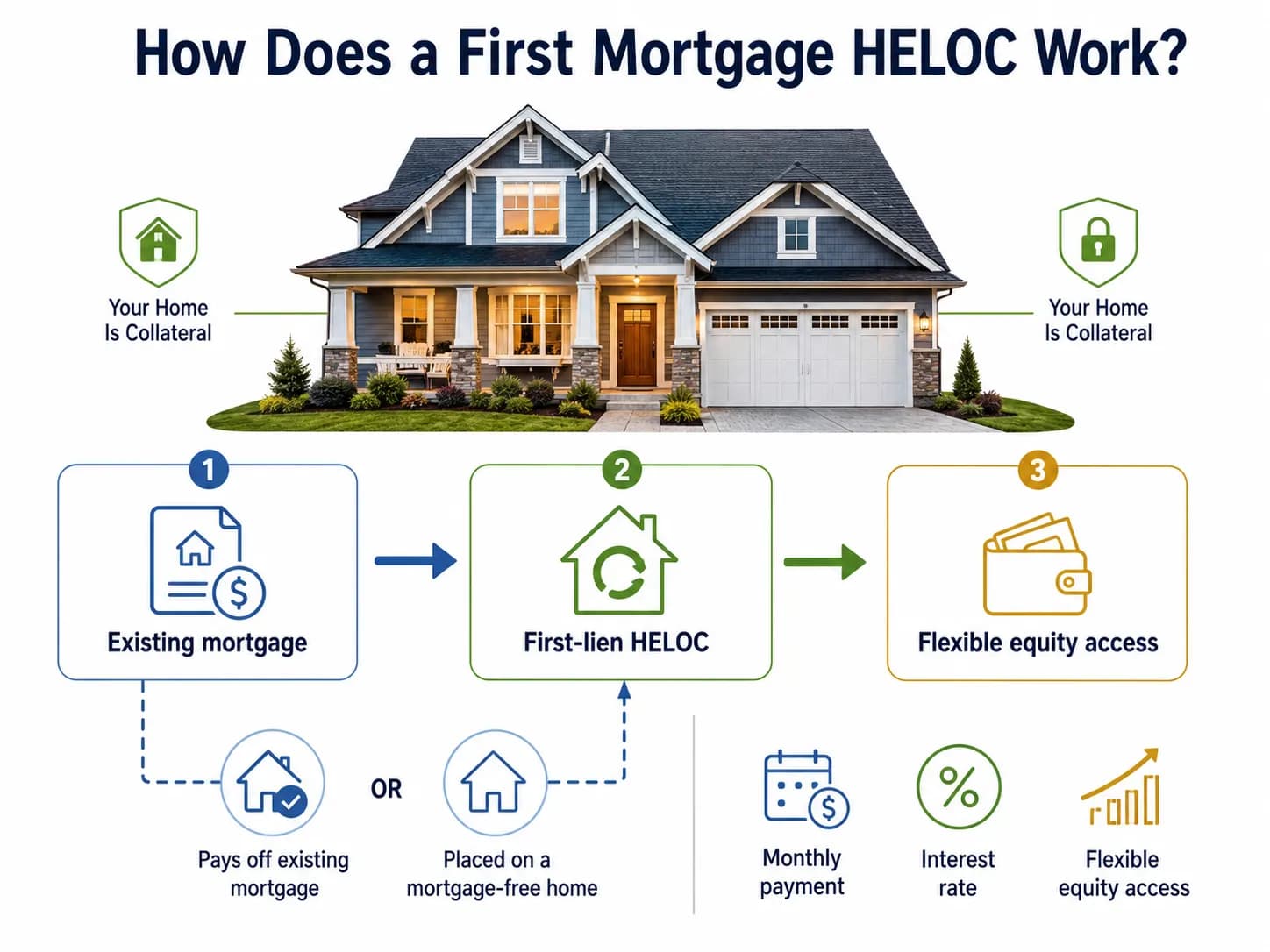
A First Mortgage HELOC is open-end credit secured in senior lien position. The CFPB explanation of a Home Equity Line of Credit describes a HELOC as repeated borrowing against home equity during the permitted draw period.
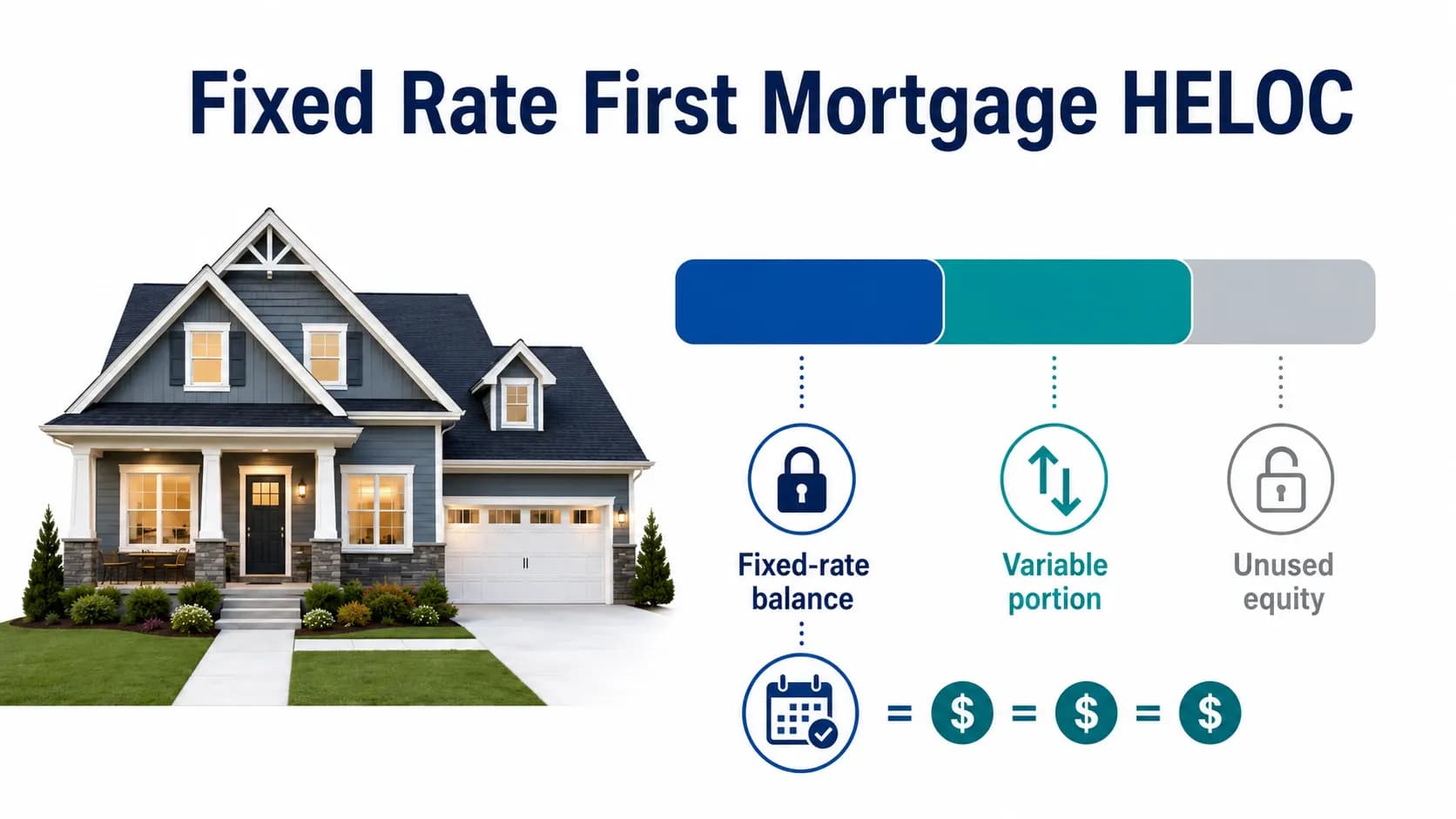
Fixed rate may apply to one draw, part of the outstanding balance, the full eligible current balance, or several segments. Each segment may have its own APR, term, payment, and amortization schedule. Any unconverted balance may remain variable.
Unused credit is not the same as borrowed principal and should not be assumed to carry the locked rate. Future draws may remain variable or qualify for different fixed terms.
First-lien position identifies priority against the property; it does not guarantee fixed pricing, approval, or lower costs. The complete First Mortgage HELOC guide explains the broader structure.
Oklahoma homeowners should confirm exactly which balance is fixed and compare the proposal with their current mortgage before proceeding.
Review Fixed Rate HELOC Options
Can the Entire First Mortgage HELOC Have a Fixed Rate?
Some products may allow the full eligible outstanding balance to be fixed. That does not automatically fix unused credit, future advances, fees, or excluded balances.
Other plans permit only partial conversions or a limited number of fixed segments. Minimum amounts, available terms, conversion frequency, and maximum balances may apply.
A HELOC can remain open-end credit after its current balance is fixed. If the revolving line closes and becomes one closed-end loan, the transaction may instead be a refinance or home equity loan.
The agreement should identify the fixed amount, fixed term, repayment method, and treatment of the remaining line.
How Does a Fixed-Rate Balance Lock or Conversion Work?
The borrower first confirms that the HELOC offers a fixed-rate feature and that the selected draw or balance is eligible.
- The lender presents the fixed APR, conversion amount, term, payment method, amortization, and fee.
- The borrower reviews and accepts the offer under the lender’s procedures.
- The selected amount becomes a fixed-rate segment.
- Unconverted balances remain subject to their variable-rate formula.
- Future draws follow the pricing rules available when they occur.
The CFPB HELOC consumer booklet recommends comparing APRs, payments, draw rules, repayment terms, fees, and conversion features.
An account statement may show separate fixed and variable obligations even when one payment is collected. Payment allocation and whether a conversion can be reversed depend on the agreement. Review how a First Mortgage HELOC works for the complete account lifecycle.

How Are Fixed-Rate Payments Calculated?
A fixed APR does not always create a fixed total account payment. The fixed segment may be predictable while variable balances, new draws, or fees change the total due.
The converted amount may use a fully amortizing principal-and-interest payment, partial amortization, or another contractual formula. The payment depends on the balance, APR, term, amortization, conversion date, and applicable charges.
A shorter term usually requires faster principal repayment; a longer term may spread payments over more time. Any variable portion may use interest-only, principal-and-interest, percentage-of-balance, or other minimum-payment rules.
Request a written breakdown for every segment and ask whether the fixed term aligns with the draw period and account maturity or could leave a balance due later. Also confirm how extra payments are applied, whether early payoff is allowed without a charge, and what happens if the HELOC closes before the fixed segment is repaid.
Do Future Draws Receive the Same Fixed Rate?
No automatic rule gives future draws the rate on an existing fixed segment. A new advance may remain variable, receive a different fixed offer, require a separate term, or fail to meet the lender’s conversion minimum.
Available pricing may depend on market conditions, account status, lender policy, conversion limits, and the remaining draw period. A separate fee may apply.
Future credit is also not guaranteed. The lender may restrict advances when permitted by the agreement and law, so unused credit should not replace emergency savings.
What Requirements May Apply to a Fixed Rate First Mortgage HELOC?
Qualification may involve approval for the HELOC and separate eligibility for a fixed-rate feature. An existing account does not guarantee that every draw, balance, term, or conversion request qualifies.
A lender may review credit, mortgage history, income, employment, debts, debt-to-income ratio, assets, reserves, property value, equity, occupancy, insurance, title, liens, requested line amount, and repayment ability.
Loan-to-value compares secured debt with supported property value. Combined loan-to-value may include other liens and, depending on methodology, the full line exposure. Equity or a strong credit score alone does not guarantee approval.
Documents may include identification, mortgage and payoff statements, pay records, tax returns, bank statements, business records, asset and debt statements, insurance, HOA information, and title documents.
Applicants can review reports through the official credit-report access website. Property and documentation standards vary. The First Mortgage HELOC requirements guide provides more detail.
Before replacing a mortgage, compare the existing rate, payoff, remaining term, proposed HELOC, and fixed-conversion rules.
Review Fixed Rate HELOC Options
What Are the Potential Benefits of a Fixed-Rate Option?
The main potential benefit is predictability for the converted balance. The borrower may know that segment’s APR, scheduled payment, and repayment term.
- Reduced exposure to later rate increases on the fixed balance
- Clearer budgeting for a known expense
- Ability to fix only the amount currently needed
- Possible continued access to unused credit
- A defined repayment path for an amortizing segment
Predictability is not guaranteed savings. The fixed rate may exceed the current variable rate, and a longer term may increase total interest. Remaining variable balances and future draws can still change the total payment.
Review the broader pros and cons of a First Mortgage HELOC before choosing revolving flexibility.
What Are the Disadvantages and Risks?
A fixed-rate feature reduces uncertainty for one balance but does not remove HELOC risk. The fixed APR may exceed the current variable rate, and a conversion fee or minimum amount may apply.
- The number or frequency of fixed segments may be limited.
- The conversion may not be reversible.
- The selected term may not match account maturity.
- Partial amortization may leave a balance due later.
- Variable balances and future draws may increase.
- The total account payment can still change.
- The home remains collateral.
Replacing a favorable fixed mortgage can introduce revolving debt, variable future draws, fees, and new closing costs. Fixed pricing does not guarantee deductibility, lower payments, savings, or continued access to credit.
What Fees, Terms, and Disclosures Should Homeowners Review?
Possible costs include application, origination, valuation, title, recording, annual, transaction, draw, inactivity, conversion, rate-lock, and early-closure fees. Not every lender charges every item.
The CFPB guidance on HELOC fees explains that a “no closing cost” offer may still involve conditions, different pricing, or reimbursement after early closure.
Review the fixed and variable APRs, index, margin, floor, caps, conversion limits, number of fixed segments, term, amortization, payment formula, balloon possibility, maturity, and future-advance rules.
Regulation Z requirements for home-equity plans address open-end disclosures. Certain principal-dwelling transactions may also involve Regulation Z right-of-rescission requirements.
Variable portions may use prime plus a lender margin. The Federal Reserve selected interest-rate data and Bank Prime Loan Rate data provide benchmark context, not a personal quote.
See First Mortgage HELOC rates and costs for a deeper explanation.
How Does a Fixed Rate First Mortgage HELOC Compare With Other Options?
The most useful comparison looks beyond the phrase “fixed rate.” Consider whether the credit is open-end or closed-end, whether the existing mortgage is replaced, how funds are accessed, and which balances can change.
| Financing option | Credit structure | Rate structure | Access to funds | Payment predictability | Main consideration |
|---|---|---|---|---|---|
| Fixed-rate First Mortgage HELOC option | Open-end revolving credit in first-lien position | Eligible balances may be fixed while other balances remain variable | Future draws may remain available under account terms | Higher for fixed segments; total account payment may still change | Confirm exactly which balance is fixed |
| Variable-rate First Mortgage HELOC | Open-end revolving credit in first-lien position | Usually index plus margin | Draws may be made during the permitted period | Lower because rates and balances can change | Consider rate and payment volatility |
| Second-lien HELOC | Open-end credit behind an existing first mortgage | Often variable, with possible fixed options | Revolving access may continue during the draw period | Depends on rate structure and balance | May preserve the existing first mortgage |
| Home equity loan | Closed-end lump-sum financing | Often fixed, although products vary | One disbursement | Generally stronger when rate and term are fixed | No revolving access to repaid principal |
| Traditional fixed-rate mortgage | Closed-end mortgage | Fixed for the loan term | Defined principal at closing | Usually high for principal and interest | Does not provide revolving access |
| Cash-out refinance | New closed-end mortgage replacing the existing loan | Fixed or adjustable | Lump-sum cash at closing | Depends on the selected product | Can replace favorable existing terms and involve closing costs |
The CFPB comparison of home equity loans and HELOCs distinguishes revolving access from a lump-sum equity loan. A fixed HELOC segment does not erase that open-end distinction.
No option is automatically best. Compare the current mortgage, first-lien effect, fixed-rate eligibility, variable exposure, future access, payment structure, fees, principal reduction, reborrowing risk, and total borrowing cost. A fixed segment may suit a known project, while a traditional mortgage may better serve a homeowner who values one stable payment and does not need reusable credit. The First Mortgage HELOC vs traditional mortgage comparison provides a deeper side-by-side review.
What Fixed-Rate HELOC Mistakes Should Homeowners Avoid?
- Assuming the full line, unused credit, or future draws share one fixed rate
- Assuming every lender offers conversions
- Assuming fixed pricing guarantees savings or a fixed total payment
- Ignoring variable balances, fees, minimums, and segment limits
- Assuming every segment fully amortizes or can be reversed
- Ignoring maturity, balloon risk, and foreclosure exposure
- Replacing a favorable mortgage without comparing total costs
- Assuming interest is automatically tax-deductible
Compare which balance is fixed, the APR, term, amortization, fees, remaining variable exposure, future-draw pricing, lien position, and long-term affordability—not the word “fixed” alone.
Review IRS Publication 936 and consult a qualified tax professional before relying on a potential deduction.
How Might a Fixed-Rate Option Work in Realistic Situations?
How Might a Homeowner Fix One Renovation Draw?
A hypothetical Tulsa homeowner converts one renovation draw into a fixed-rate segment. The unused line may remain available, while later draws may use variable or separately offered fixed pricing.
How Might Fixed and Variable Balances Exist Together?
A hypothetical Broken Arrow homeowner converts part of the balance. That portion has a fixed payment structure, while another balance remains variable, so the total account payment can still change.
How Might a Homeowner Compare a Fixed HELOC Segment With a Home Equity Loan?
A fixed HELOC segment may preserve revolving access, while a home equity loan generally provides one closed-end lump sum. Compare APR, term, payment, fees, lien position, future access, total interest, and reborrowing risk.
These examples are educational. They do not promise a rate, payment, savings amount, or future credit availability.
What Should Homeowners Review Before Applying or Converting a Balance?
Compare written offers using the same facts:
- Current mortgage balance, rate, term, payment, and payoff
- Property value, equity, LTV, CLTV, title, liens, and insurance
- Credit, income, employment, debts, assets, and reserves
- Requested line, expected draw, and intended use
- Variable index, margin, APR, floor, and caps
- Fixed APR, conversion amount, fee, term, and amortization
- Conversion minimums, frequency, and segment limits
- Fixed and variable payment amounts
- Future-draw pricing and credit-access conditions
- Draw-period end, maturity, and balloon possibility
- Valuation, title, annual, transaction, and early-closure fees
- Alternative financing and higher-payment scenarios
The HELOC FAQ library for Oklahoma homeowners provides additional guidance.
A mortgage review can clarify whether the proposal fixes one segment, the entire eligible balance, or replaces the line with a different product. Homeowners should also compare a higher-rate scenario for any variable portion and confirm that the repayment plan still works if future borrowing increases the balance.
Review Fixed Rate HELOC Options
What Should Readers Verify Before Relying on This Guide?
This article is general mortgage education, not a quote, commitment, approval decision, financial plan, legal advice, or tax advice.
A Fixed Rate First Mortgage HELOC does not guarantee approval, a credit limit, fixed pricing on the full line or future draws, conversion eligibility, a fixed total payment, savings, continued access, tax deductibility, or a specific outcome.
Results depend on the lender, borrower, property, equity, title, liens, account terms, market conditions, underwriting, and applicable law. Rates, fees, product features, qualifications, disclosures, and tax rules can change.
Reviewed by: Jeff Leek
Reviewer NMLS: 303051
Last reviewed: June 24, 2026
What Questions Do Homeowners Ask About Fixed Rate First Mortgage HELOCs?
What Is a Fixed Rate First Mortgage HELOC?
It is generally a first-lien revolving line that may allow an eligible draw or balance to receive fixed pricing while other portions remain variable.
Are All First Mortgage HELOCs Fixed Rate?
No. Many HELOCs use variable rates. Fixed-rate features depend on the lender and agreement.
Can the Entire HELOC Balance Be Fixed?
Some products may fix the full eligible outstanding balance; others allow only selected draws or partial balances.
Do Future Draws Receive the Same Fixed Rate?
Not automatically. Future draws may remain variable or require a separate conversion using then-available terms.
Can a Fixed-Rate HELOC Payment Still Change?
The fixed-segment payment may be predictable, but variable balances, new draws, or fees can change the total due.
Does a Fixed-Rate Conversion Cost Money?
It may. Conversion fees, minimum balances, segment limits, or other conditions can apply.
Is a Fixed-Rate HELOC the Same as a Home Equity Loan?
No. A HELOC generally remains open-end credit; a home equity loan usually provides one closed-end lump sum.
Is a Fixed Rate First Mortgage HELOC Better Than a Traditional Mortgage?
That depends on the current mortgage, rates, equity, fees, future borrowing needs, repayment behavior, and long-term affordability.