First Mortgage HELOC Requirements You Need to Know
Many homeowners build substantial equity over time but still feel uncertain about whether they may qualify for a first-lien home equity line of credit. Some wonder whether their existing mortgage must be paid off, how variable payments may work, or how lenders review income, debts, and property value before approving a line of credit.
First Mortgage HELOC Requirements can vary depending on the lender, property type, lien position, available equity, credit profile, title review, and underwriting standards. A first mortgage HELOC may provide revolving access to home equity while holding first lien position, but approval, available credit, repayment terms, rates, and fees are never automatic.
This guide explains how first-lien HELOC qualification may work, including credit review, debt-to-income ratio, property valuation, lien-position requirements, repayment structures, variable APR considerations, documentation requirements, and alternative financing options.
What Are First Mortgage HELOC Requirements?
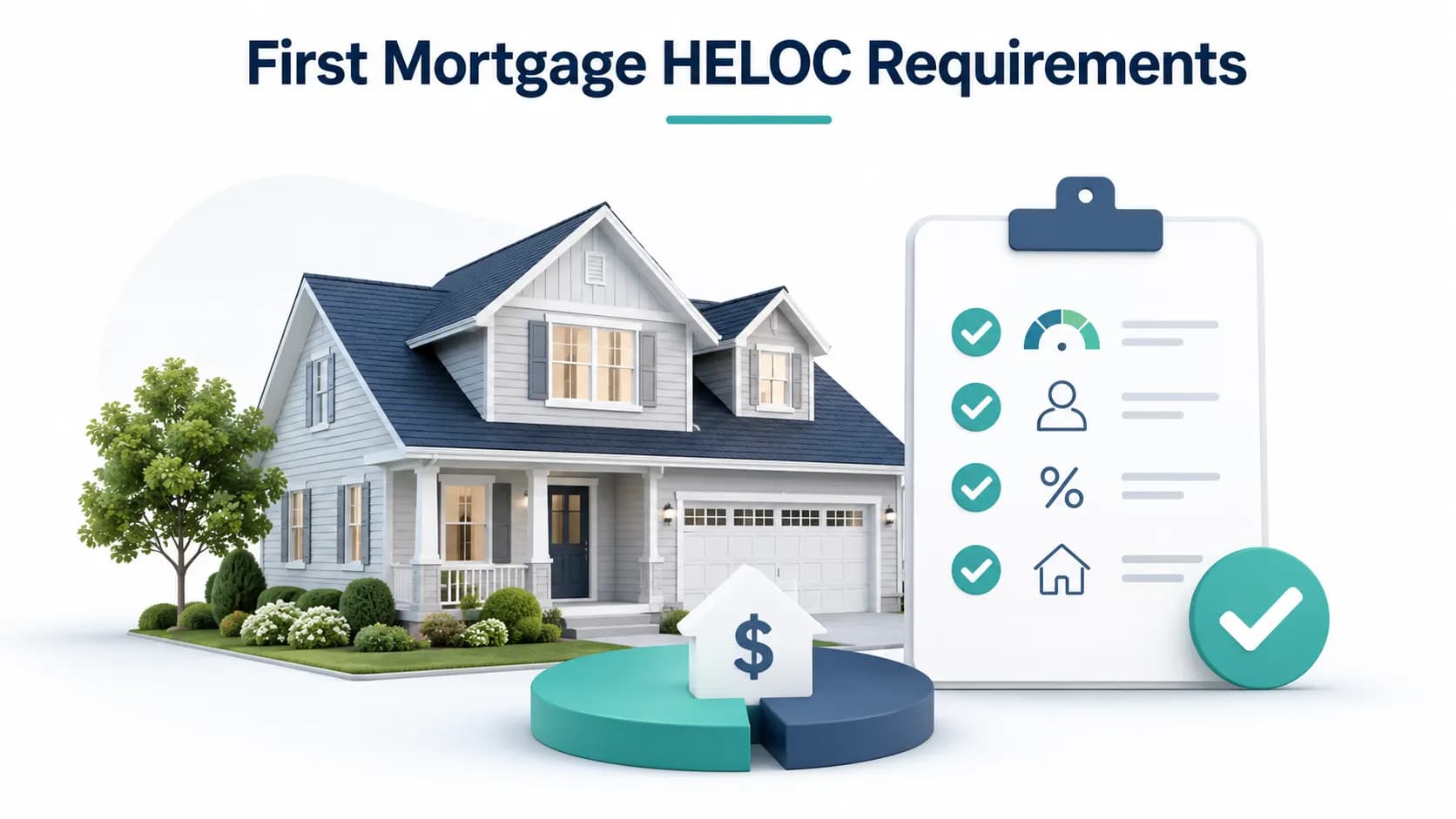
First Mortgage HELOC Requirements may include acceptable credit history, verifiable income, manageable debt obligations, sufficient home equity, confirmed property value, homeowners insurance, clear title review, and the ability to place the HELOC in first lien position. Lenders may also review repayment ability, occupancy, and property eligibility. Qualification standards vary by lender and borrower profile.
What Are the Main Requirements for a First Mortgage HELOC?
A lender generally reviews both the homeowner and the property before approving a first-lien HELOC. Common review factors may include credit history, income stability, debt-to-income ratio, home equity, property value, title findings, insurance coverage, occupancy type, and lien priority.
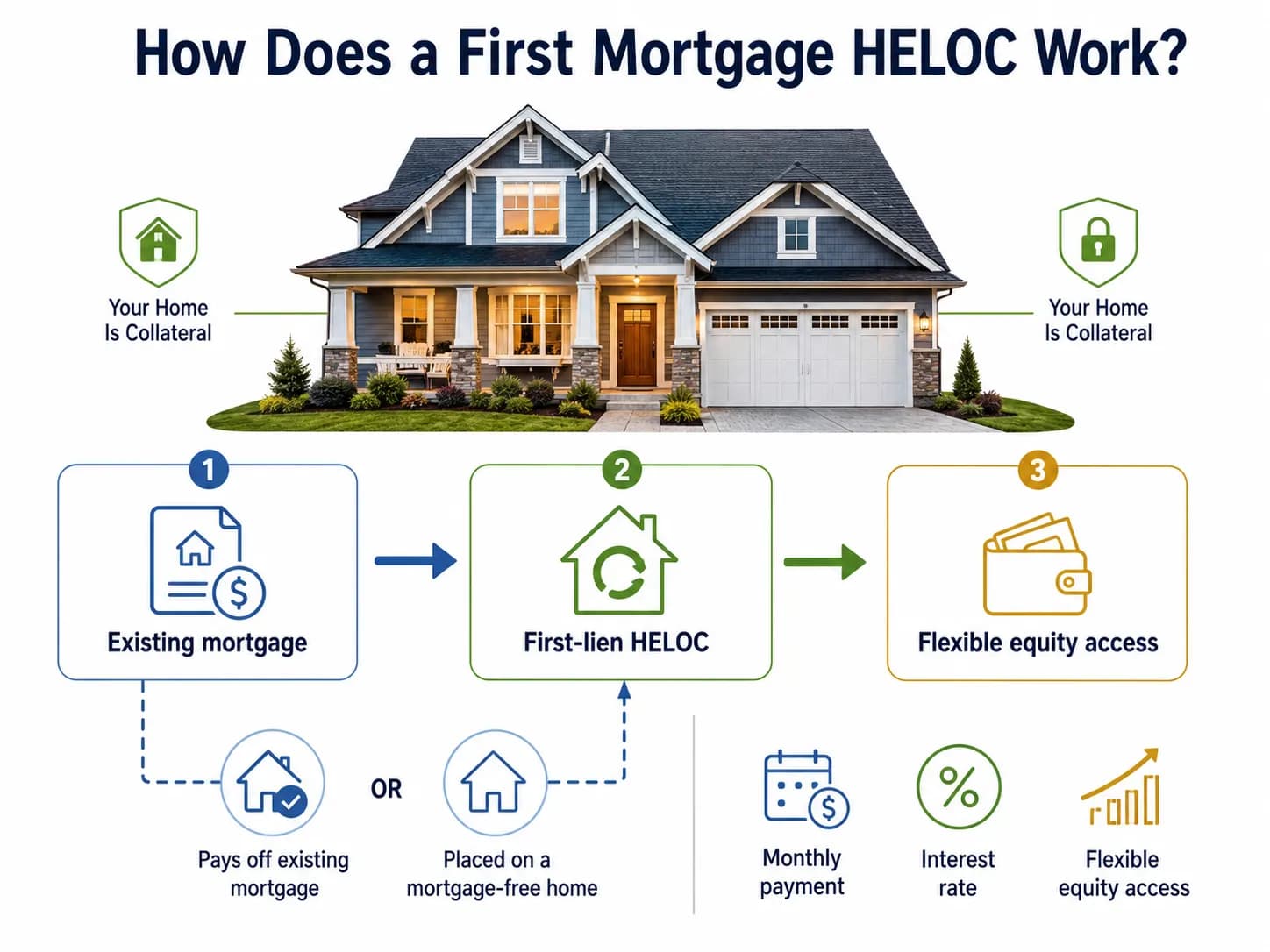
A first mortgage HELOC usually needs to hold first lien position. If a homeowner already has an existing mortgage, that balance may need to be paid off so the HELOC can move into senior lien position.
Some homeowners assume that strong equity automatically guarantees approval. However, lenders may still decline applications because of debt obligations, title concerns, credit issues, or property eligibility requirements.
The approved credit line may also differ from the amount requested. Some lenders may offer reduced line amounts based on underwriting, valuation results, repayment ability, or property-related concerns.
Not every lender or mortgage company currently offers first-lien HELOC products. Homeowners can review the website’s complete First Mortgage HELOC guide to better understand lien position, revolving access, payment structures, costs, and potential risks.
According to the CFPB HELOC definition, a home equity line of credit is generally a revolving line secured by the home.
Before replacing an existing mortgage or selecting a variable-rate line of credit, homeowners should carefully review repayment terms, lien-position requirements, and long-term affordability.
Review First Mortgage HELOC Options
How Does a First Mortgage HELOC Work?
A first mortgage HELOC is generally an open-end revolving line of credit secured by a property in first lien position. During the draw period, eligible homeowners may borrow, repay, and borrow again subject to account terms and available credit.
If the homeowner currently has an existing mortgage, that balance may need to be paid off through the new transaction so the HELOC can move into first position.
A first-lien HELOC differs from a second-lien HELOC because the first-lien product holds senior priority against the property. A second-lien HELOC generally remains subordinate to the existing mortgage.
The approved line amount is not the same as the amount currently borrowed. Interest is generally charged on the outstanding balance, although fees and account charges may also apply.
Some agreements may permit lenders to reduce, suspend, or freeze future advances under certain conditions allowed by the agreement or applicable law.
Homeowners comparing repayment structures may benefit from reviewing the CFPB HELOC brochure and the CFPB comparison of home equity loans and HELOCs.

What Credit, Income, and Debt Requirements May Apply?
Lenders may review credit score, mortgage payment history, credit utilization, debt obligations, recent late payments, collections, bankruptcies, or foreclosure history when evaluating qualification.
There is no universal minimum credit score for every lender or product. Many lenders evaluate the complete credit profile rather than focusing on only one score.
Income review is also important. Lenders may evaluate employment history, stable earnings, commission income, bonus income, rental income when permitted, and overall repayment ability.
Self-employed homeowners may need additional documentation such as tax returns, business bank statements, or profit-and-loss statements. Income usually needs to be documented and reasonably expected to continue according to lender requirements.
Debt-to-income ratio standards can vary. Lenders may consider DTI together with reserves, equity position, repayment history, and the full risk profile.
Homeowners preparing to apply may benefit from reviewing reports available through AnnualCreditReport.com.
Additional answers about credit, equity, rates, draw periods, payments, and qualification are available in the website’s HELOC FAQ library for Oklahoma homeowners.
How Much Home Equity May Be Needed?
Home equity generally represents the difference between the property’s value and debts secured against the property. Lenders often review both loan-to-value ratio and combined loan-to-value ratio when evaluating eligibility.
LTV compares the borrowing exposure against the property value. CLTV may include multiple liens or the full available credit-line exposure depending on lender methodology.
Some lenders calculate qualification using the full requested credit line rather than only the amount initially borrowed. That means available credit exposure can affect underwriting decisions.
Online property estimates are not always final valuation results. Depending on the file, a lender may use an appraisal, desktop valuation, automated valuation model, or another permitted valuation method.
A lower-than-expected valuation can reduce available credit or affect qualification. Appraisal requirements, LTV limits, and equity standards can vary by lender and property type.
The CFPB Regulation B valuation requirements explain certain homeowner rights related to appraisal or valuation copies when applicable.
What Property, Title, and Lien Requirements May Apply?
Property eligibility rules may differ depending on the lender and product structure. Lenders may review occupancy type, property condition, insurance coverage, HOA obligations, flood-zone status, and title findings.
Eligible properties may include primary residences, second homes, or certain investment properties depending on underwriting guidelines. Condominium approval status or manufactured-home eligibility may also affect qualification.
Because a first mortgage HELOC generally needs to hold first lien position, lenders may review existing mortgages, tax liens, judgment liens, HOA liens, mechanic’s liens, or solar-related obligations recorded against the property.
Existing liens may need to be released, paid off, subordinated, or otherwise resolved before closing. However, not every title issue automatically prevents approval.
Homeowners should also review how lien position, credit, property value, and product terms may affect First Mortgage HELOC rates and borrowing costs.
What Documents May Be Needed for a First Mortgage HELOC?
The exact documentation checklist varies, but lenders commonly request:
- Government-issued identification
- Recent pay stubs
- W-2 forms or 1099 forms
- Personal or business tax returns
- Bank statements and asset statements
- Mortgage payoff statements
- Property-tax information
- Insurance documentation
- Employment verification
- Debt statements
Submitting complete and accurate documentation may reduce avoidable delays, but it does not guarantee approval.
Mortgage professionals may also help homeowners organize documents and review potential qualification concerns before formal underwriting begins.
Homeowners researching disclosure requirements may benefit from reviewing Regulation Z home equity plan requirements.
Borrowers can also review the website’s broader mortgage FAQ library for additional answers about HELOCs, loan programs, documentation, and Oklahoma mortgage guidance.
Before replacing an existing mortgage or relying on estimated property value, homeowners should carefully review title concerns, repayment structure, and variable-rate risk with a mortgage professional.
Review First Mortgage HELOC Options
How Do First Mortgage HELOC Rates and Payments Work?
Many HELOCs use variable APR structures. The APR may be based on an index plus a lender margin, and the agreement may include rate floors or rate caps.
Payments may increase or decrease over time depending on interest-rate changes, borrowing activity, and repayment stage.
The draw period generally allows eligible advances, while the repayment period usually begins after the draw period ends. During repayment, additional borrowing may no longer be permitted.
Some HELOCs may allow interest-only minimum payments during part of the draw period. Interest-only payments generally do not create meaningful principal reduction unless extra principal payments are made.
Some products may offer fixed-rate conversion options for certain balances, although those features are not universal.
Homeowners concerned about long-term affordability can explore educational scenarios with the website’s loan comparison calculator. Calculator results should not be treated as a loan quote, approval decision, or guaranteed payment.
What Fees, Closing Costs, and Disclosures Should Be Reviewed?
Possible costs may include application fees, appraisal fees, title charges, recording fees, annual fees, transaction charges, flood-determination fees, or early termination fees.
Not every fee applies to every product. In some cases, “no closing cost” advertising may mean certain costs are absorbed into pricing or tied to early closure conditions.
Because first mortgage HELOCs are generally open-end credit products, disclosures may differ from the Loan Estimate and Closing Disclosure process commonly associated with many closed-end mortgages.
Homeowners should carefully review the APR calculation method, repayment structure, draw period, fees, conditions for additional advances, and repayment-change risks.
The CFPB HELOC fee guidance and Regulation Z right-of-rescission requirements may help homeowners better understand disclosure protections.
A federal right of rescission may apply to certain transactions secured by a principal dwelling, although applicability depends on the product structure and applicable law.
How Does a First Mortgage HELOC Compare With Other Equity Options?
| Financing option | What happens to the existing mortgage | Rate and payment structure | Access to funds | Main qualification or risk consideration |
|---|---|---|---|---|
| First mortgage HELOC | May replace the existing mortgage | Often variable-rate revolving credit | Flexible borrowing during draw period | Variable-rate and first-lien risk |
| Second-lien HELOC | Existing mortgage generally remains | Variable-rate revolving structure | Flexible revolving access | Subordinate lien position |
| Home equity loan | Existing mortgage may remain | Often fixed-rate closed-end payments | Lump-sum distribution | Less borrowing flexibility |
| Cash-out refinance | Current mortgage replaced | Closed-end mortgage payments | One-time equity withdrawal | New mortgage terms and costs |
| Rate-and-term refinance | Current mortgage replaced | Closed-end mortgage structure | Not designed for revolving access | Limited equity flexibility |
No financing option is automatically best for every homeowner. Some borrowers prioritize predictable payments, while others prioritize flexible access to funds.
Homeowners can explore additional mortgage and home-equity articles before comparing a first-lien HELOC with a refinance, second-lien HELOC, home equity loan, or traditional mortgage.
The CFPB overview of HELOC alternatives provides additional general information about related borrowing structures.
What First Mortgage HELOC Mistakes Should Homeowners Avoid?
Some homeowners assume strong equity guarantees approval or believe every lender offers first-lien HELOC products. Others focus only on introductory rates without reviewing repayment risk, fees, or future payment adjustments.
Common mistakes may include ignoring title concerns, misunderstanding lien position, assuming interest-only payments reduce principal, or treating online property estimates as guaranteed valuations.
Homeowners should also avoid assuming the full credit line will always remain available or believing a HELOC automatically pays a mortgage off faster.
Homeowners should compare a first mortgage HELOC based on qualification requirements, lien position, variable-rate risk, payment structure, fees, access to funds, and long-term affordability—not only the starting rate or advertised minimum payment.
The FTC guidance on home equity loans and HELOCs provides additional educational information about repayment risks and borrowing considerations.
What Hypothetical Examples Explain These Requirements?
Could a Homeowner Replace an Existing Mortgage With a First-Lien HELOC?
A lender may review the mortgage payoff amount, title findings, insurance coverage, property value, debt obligations, and whether the new HELOC can obtain first lien position. Final approval would still depend on underwriting and product availability.
Could a Self-Employed Homeowner Meet the Income Requirements?
Some self-employed homeowners may qualify if they can document stable income through tax returns, business records, profit-and-loss statements, and bank statements. Self-employment alone does not automatically prevent qualification.
Could a Homeowner Use a First Mortgage HELOC to Pay a Home Off Faster?
Potential payoff outcomes depend on permanent principal reduction, repayment behavior, spending discipline, fees, interest-rate changes, and whether borrowed funds are repeatedly drawn again. The HELOC structure alone does not guarantee faster payoff or interest savings.
How Should Homeowners Prepare Before Applying?
- Review current mortgage payoff information
- Estimate property value carefully
- Review title and lien concerns
- Check recent mortgage-payment history
- Gather income and employment records
- Review monthly debts and debt-to-income ratio
- Organize insurance and property-tax documents
- Compare variable-rate repayment scenarios
- Review possible fees and repayment terms
- Compare alternative financing structures
Homeowners can review Jeff Leek’s Oklahoma mortgage and home-equity guidance before making a major borrowing decision.
Before relying on estimated equity or selecting a variable-rate line of credit, homeowners should compare repayment structures, long-term affordability, and available alternatives with a qualified mortgage professional.
Review First Mortgage HELOC Options
What Do Homeowners Ask About First Mortgage HELOC Requirements?
What Are First Mortgage HELOC Requirements?
Requirements may include credit review, verifiable income, debt analysis, home equity review, valuation confirmation, insurance verification, title review, and the ability to place the HELOC in first lien position.
What Credit Score Is Needed for a First Mortgage HELOC?
Lenders establish different standards, and no universal credit score guarantees approval. Many lenders evaluate the full credit profile instead of relying on only one score.
How Much Equity Do I Need for a First Mortgage HELOC?
Equity requirements and LTV or CLTV limits vary depending on the lender, property type, requested line amount, and borrower profile.
Can a First Mortgage HELOC Replace My Current Mortgage?
Some first-lien HELOC transactions may pay off an existing mortgage so the HELOC can become the senior lien, subject to lender, title, and underwriting requirements.
Does a First Mortgage HELOC Require an Appraisal?
A lender may use an appraisal or another permitted valuation method depending on the property, product, and underwriting requirements.
Are First Mortgage HELOC Rates Fixed or Variable?
Many HELOCs use variable APR structures, although some products may offer fixed-rate options for certain balances.
What Documents Are Needed for a First Mortgage HELOC?
Requirements may include identification, income documents, asset records, mortgage information, insurance documents, and title-related information.
Is a First Mortgage HELOC Better Than a Cash-Out Refinance?
The right option depends on repayment goals, payment stability preferences, existing mortgage terms, access-to-funds needs, fees, and long-term affordability.
What Should Homeowners Know Before Relying on This Guide?
This educational content should be reviewed for accuracy by a licensed mortgage professional before publication. First Mortgage HELOC Requirements information is educational only and should not be treated as individualized financial, legal, or tax advice.
A first mortgage HELOC does not guarantee approval, lower payments, lower interest costs, continued access to the full line, faster payoff, fixed rates, lower closing costs, or specific closing timelines.
Approval and final terms depend on lender underwriting, credit history, debts, income, employment, property value, title findings, lien position, occupancy, insurance coverage, and applicable law. Rates, fees, APRs, repayment structures, and product availability may change over time.
Reviewed by: Jeff Leek
Reviewer NMLS: 303051
Last reviewed: June 23, 2026