How Does a First Mortgage HELOC Work? Simple Breakdown
A Tulsa-area homeowner may have substantial equity but still feel unsure about replacing a traditional mortgage with a revolving credit line. The phrase How Does a First Mortgage HELOC Work? often appears when someone wants flexible access to equity but needs to understand what happens to the existing mortgage, monthly payment, interest rate, and home.
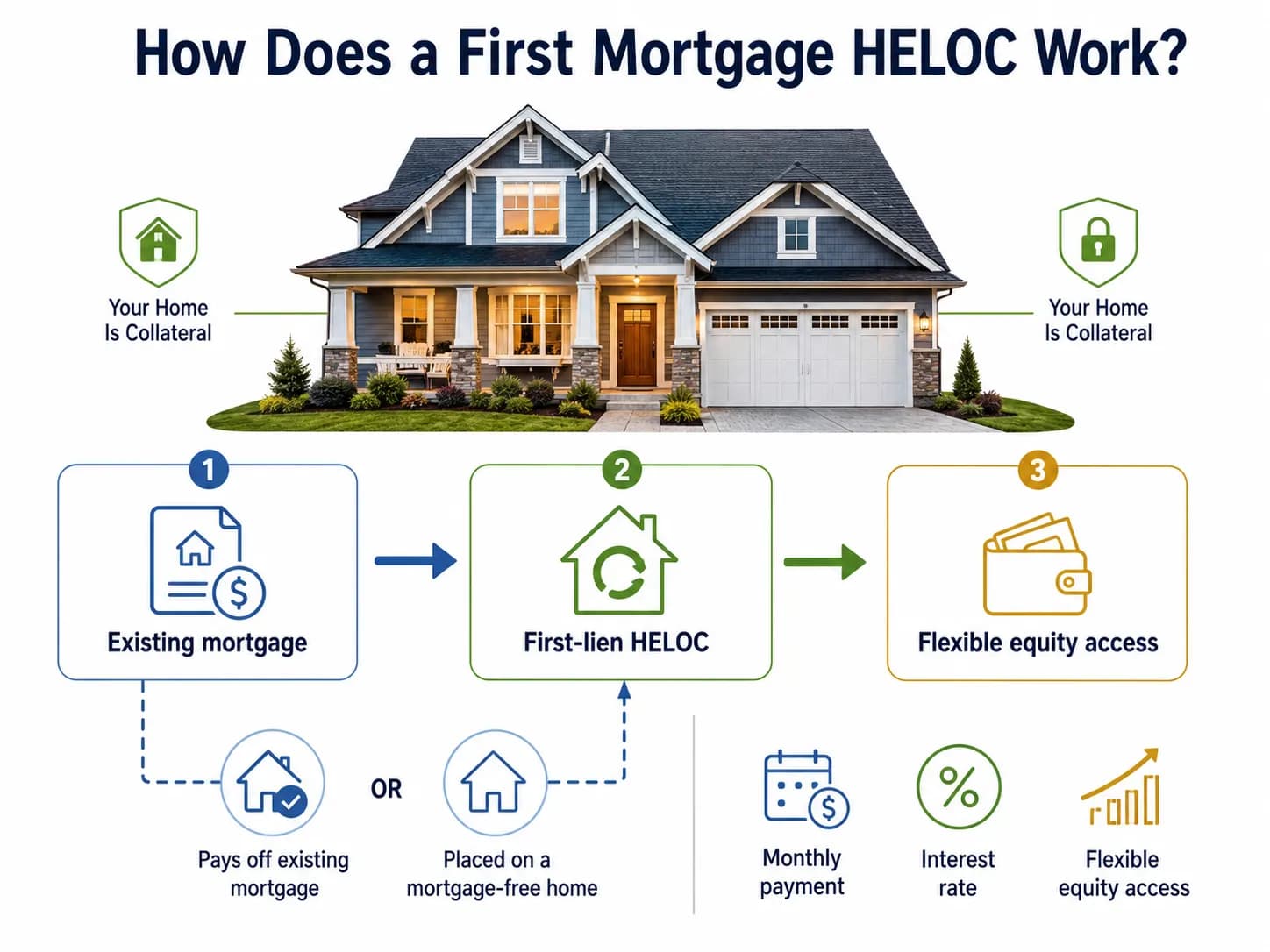
A First Mortgage HELOC is generally a Home Equity Line of Credit recorded in first-lien position. It may pay off an existing mortgage or become the first lien on a mortgage-free property. Final terms depend on the lender, property, borrower, and written agreement.
How Does a First Mortgage HELOC Work?
A First Mortgage HELOC is generally an open-end revolving credit line secured in first-lien position. The homeowner receives an approved limit and may borrow, repay principal, and potentially reuse available credit during the draw period. Interest, payments, future access, and repayment depend on the lender’s written account terms.
What Makes a HELOC a First Mortgage?
“First mortgage” describes lien priority. A first-lien HELOC holds the senior recorded claim against the property, while a second-lien HELOC usually sits behind an existing mortgage. The CFPB explanation of a Home Equity Line of Credit describes a HELOC as open-end credit that allows repeated borrowing against home equity.
If a conventional mortgage already occupies first position, that loan may need to be paid off or otherwise addressed before the new HELOC can become the senior lien. The payoff may become the initial balance on the line. When the property is mortgage-free, the HELOC may become the first recorded lien without replacing another mortgage.
First position affects title and foreclosure priority, but it does not make the debt safer for the homeowner. The property secures the account, and failure to meet the agreement can place the home at risk. Homeowners in Tulsa, Broken Arrow, Bixby, Jenks, Owasso, Glenpool, Sapulpa, Coweta, and nearby Oklahoma communities can review the complete First Mortgage HELOC guide for broader product context.
Before changing lien position, it helps to compare the existing mortgage with the proposed line, including rate stability, fees, payment rules, and long-term affordability.
Review First Mortgage HELOC Options
What Happens From Application to Account Opening?
The process begins with a borrowing goal, such as renovations, a flexible reserve, debt consolidation, or mortgage replacement. The homeowner then reviews the current balance, payoff amount, property value, liens, and requested limit.
- Application: The homeowner provides personal, financial, employment, and property information.
- Credit and income review: The lender evaluates credit history, debts, income stability, and ability to repay.
- Property review: An appraisal, automated valuation model, desktop review, or another accepted method may be used.
- Title review: The lender identifies existing mortgages, tax liens, judgments, HOA claims, or other recorded interests.
- Lien-position review: The lender determines whether the proposed HELOC can obtain first position.
- Disclosure review: The homeowner receives applicable account-opening information and should review rates, fees, payment formulas, and account restrictions.
- Closing and funding: Applicable conditions are completed, existing debt may be paid off, and the account opens with an initial outstanding balance when required.
The credit limit is not the amount already borrowed. A homeowner may receive an approved line but use only enough to pay off a mortgage or fund a project. Interest is generally tied to the outstanding balance, subject to the agreement.
The CFPB HELOC consumer booklet can help homeowners identify questions about shopping, payments, fees, and potential restrictions. Certain principal-dwelling transactions may also include a federal rescission period, depending on the structure and applicable law.
A First Mortgage HELOC may involve first-lien placement, revolving access during the draw period, and principal repayment under the account terms.
How Do the Draw and Repayment Periods Work?
The draw period is the phase when the homeowner may access available credit. Depending on the lender, funds may be available through account transfers, checks, a card, or another approved method. Some products require an initial draw or minimum transaction amount.
During the draw period, the borrower may repay principal. Many plans restore repaid principal to available credit, allowing it to be borrowed again, but reborrowing is subject to the agreement and continued account availability. The lender may be permitted to reduce, suspend, or freeze future advances under certain circumstances, such as a significant property-value decline or a material change in repayment ability.
The repayment period begins when new draws generally stop. The remaining balance must then be repaid according to the account terms. Payments may rise because principal repayment starts, the variable rate changes, or both. Some plans amortize the balance over a stated period, while another structure may leave a larger amount due at maturity.
The FTC home equity loan and HELOC guidance explains why homeowners should compare repayment terms and understand that the home secures the debt. The site’s HELOC FAQ library for Oklahoma homeowners also answers common questions about equity, borrowing, rates, and repayment.

How Are Interest and Monthly Payments Calculated?
Interest is generally calculated on the outstanding balance rather than the unused portion of the credit limit. The agreement controls the exact calculation, timing, compounding method, and minimum-payment formula.
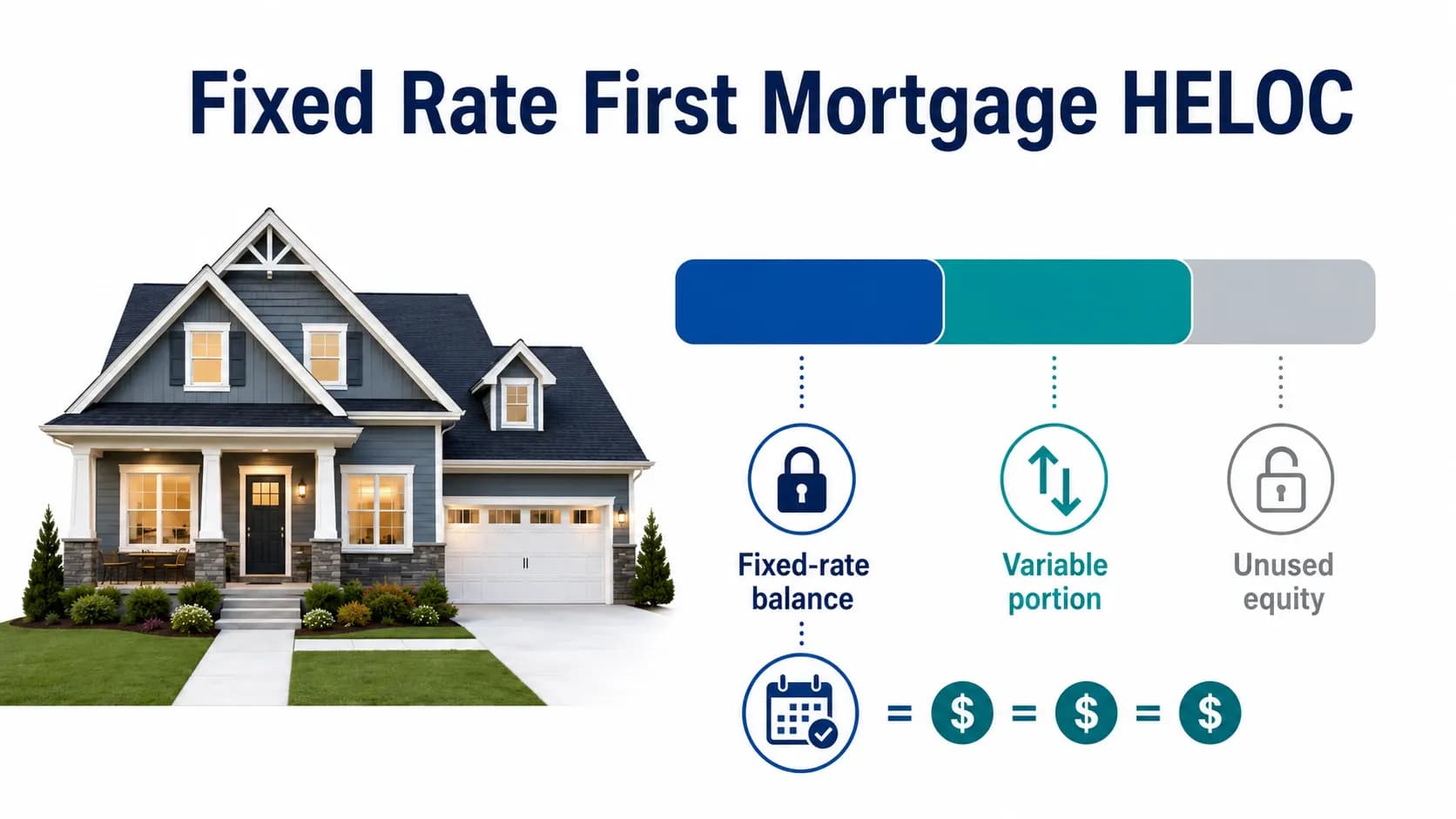
Many HELOCs use a variable annual percentage rate. The rate may equal a benchmark index plus a lender margin. Some lenders use the bank prime rate as the index, but prime is not automatically the borrower’s final rate. Homeowners can review Federal Reserve selected interest-rate data and the Bank Prime Loan Rate data to understand the benchmark, while relying on the lender’s disclosures for actual pricing.
A promotional rate may apply for a limited period. After it ends, the rate may reset using the stated index and margin. A rate floor can limit how low the rate may fall, while periodic or lifetime caps may limit increases. Caps do not create a fixed payment.
Minimum payments may be interest-only, principal and interest, a percentage of the balance, a fixed minimum, or another formula. Interest-only payments generally do not reduce principal. Payments can change when the rate moves, the homeowner borrows more, the promotional period ends, or the account enters repayment.
Because product structures vary, homeowners should review the lender’s formula rather than relying on a generic online example. The guide to First Mortgage HELOC rates and costs provides more detail about rate components and pricing questions.
What Happens to the Existing Mortgage and Lien Position?
For a HELOC to function as the first mortgage, it generally must obtain senior lien priority. An existing first mortgage may therefore need to be paid off as part of the transaction. The payoff amount may become part of the HELOC’s starting balance, while any unused portion remains available subject to the account terms.
Title work may reveal other recorded claims, including a second mortgage, tax lien, judgment lien, mechanic’s lien, HOA lien, or property-secured solar obligation. A lien may need to be paid, released, subordinated, or reviewed before the new line can close.
Replacing a fixed-rate mortgage with variable-rate credit may affect rate stability, total interest exposure, closing costs, repayment behavior, and future credit. A low introductory payment should not be the only comparison point.
First-lien priority gives the lender a senior claim against the collateral. It does not guarantee better pricing, lower total costs, or a faster payoff. Homeowners should compare the current mortgage rate and remaining term with the proposed index, margin, fees, minimum-payment formula, and repayment schedule.
What Requirements, Equity, and Documents May Apply?
Qualification depends on the lender, product, property, and borrower profile. Strong equity or a high credit score can help, but neither guarantees approval or a particular credit limit.
A lender may review:
- Credit score, credit history, payment history, utilization, collections, and major credit events
- Employment, salaried income, self-employment income, and income stability
- Monthly debts, debt-to-income ratio, assets, and cash reserves
- Property value, occupancy, property type, insurance, and flood-zone status
- Existing mortgage balances, liens, requested credit limit, and initial draw
- Loan-to-value ratio and combined loan-to-value ratio
Loan-to-value generally compares secured debt with property value. Combined loan-to-value may include all property liens or the full credit-line exposure, depending on the lender’s method. A lower valuation can reduce the available line even when the homeowner’s income and credit are otherwise acceptable.
Documents may include identification, mortgage statements, payoff information, pay stubs, W-2s, 1099s, tax returns, bank statements, profit-and-loss statements, insurance records, property-tax information, HOA documents, and title-related items. Homeowners can obtain credit reports through the official credit-report access website before applying.
Requirements can differ for primary residences, second homes, investment properties, condominiums, manufactured homes, and multi-unit properties. Review the detailed First Mortgage HELOC requirements before relying on a general qualification estimate.
A mortgage professional can help compare equity, documents, projected payments, and alternatives before the homeowner replaces an existing mortgage or pays application-related costs.
Review First Mortgage HELOC Options
What Costs, Fees, and Disclosures Should Homeowners Review?
Potential costs may include application, origination, credit-report, valuation, appraisal, title-search, title-insurance, settlement, recording, flood-determination, annual, maintenance, transaction, inactivity, fixed-rate conversion, and early-closure fees. Not every lender charges every fee.
A “no closing cost” offer may include conditions. The lender may absorb selected costs but charge different pricing, require the account to remain open for a stated period, or require reimbursement if the line closes early. The written agreement and fee schedule control.
First Mortgage HELOCs are generally open-end credit. Their disclosures can differ from the Loan Estimate and Closing Disclosure commonly used for many closed-end mortgages. Homeowners should review the APR, index, margin, adjustment frequency, rate floor, caps, payment formula, initial draw, transaction limits, draw period, repayment period, maturity terms, and circumstances that may restrict advances.
The Regulation Z requirements for home-equity plans address disclosures and account terms for certain open-end home-equity plans. The Regulation Z right-of-rescission requirements may apply to certain transactions involving a principal dwelling. Applicability depends on the transaction, so borrowers should seek legal guidance for legal questions.
How Does a First Mortgage HELOC Compare With Other Options?
| Financing option | What happens to the existing mortgage | How funds are accessed | Typical rate or payment structure | Main consideration |
|---|---|---|---|---|
| First Mortgage HELOC | May pay off and replace it to obtain first position | Revolving draws up to available credit | Often variable and balance-dependent | Flexibility must be weighed against rate and payment risk |
| Second-lien HELOC | Usually remains in place | Revolving draws | Often variable | Creates an additional lien and payment |
| Home equity loan | Usually remains in place | One lump sum | Often fixed principal-and-interest payments | Predictability with less borrowing flexibility |
| Cash-out refinance | Replaced by a new closed-end mortgage | Cash received at closing | Fixed or adjustable amortizing payment | New terms apply to the entire refinanced balance |
| Traditional mortgage | Establishes or retains the primary mortgage | Defined principal amount | Usually scheduled amortizing payments | Less revolving flexibility but potentially greater predictability |
The CFPB comparison of home equity loans and HELOCs explains the basic difference between a lump-sum loan and revolving credit. A First Mortgage HELOC adds another decision: whether replacing the existing mortgage is worth the change in rate stability, costs, lien structure, and borrowing behavior.
No option is automatically best. Homeowners should compare rate stability, closing costs, access to future funds, payment predictability, principal reduction, total borrowing cost, and long-term affordability. The First Mortgage HELOC vs traditional mortgage comparison provides a focused review of those tradeoffs.
What Risks and Mistakes Should Homeowners Avoid?
Common mistakes include comparing only the introductory rate, assuming the full line will remain available, and replacing a favorable fixed mortgage without testing higher payments. Repeatedly borrowing repaid principal can also prevent lasting balance reduction.
- Do not assume every lender offers a first-lien HELOC or that equity guarantees approval.
- Do not assume unused credit is guaranteed emergency cash.
- Do not assume prime is the final borrower rate; the lender margin also matters.
- Do not assume interest-only payments reduce principal.
- Do not ignore the end of the draw period or a possible payment increase.
- Do not overlook annual, transaction, inactivity, valuation, title, or early-closure costs.
- Do not treat “no closing cost” as meaning there are no conditions.
- Do not rely on a mortgage-acceleration claim without reviewing the complete cash-flow assumptions.
Compare a First Mortgage HELOC by lien position, index, margin, rate caps, minimum-payment formula, draw period, repayment period, fees, borrowing behavior, and long-term affordability—not only the opening rate or minimum payment.
Homeowners should also ask questions to ask First Mortgage HELOC lenders about credit-line restrictions, fixed-rate features, maturity, and early closure. When interest deductibility is part of the decision, review IRS Publication 936 and consult a qualified tax professional. Tax treatment depends on individual circumstances and current law.
How Might a First Mortgage HELOC Work in Real-Life Situations?
How Might It Work for a Homeowner With an Existing Fixed Mortgage?
The lender reviews the current payoff amount, property value, title, and requested line. If approved, the HELOC may pay off the fixed mortgage and become the first lien. The payoff becomes part of the initial balance, while remaining credit may be available for later draws. The homeowner should compare variable-rate exposure with the stability and remaining term of the existing loan.
How Might It Work for a Mortgage-Free Homeowner?
A homeowner without a mortgage may open a line that becomes the first recorded lien. The borrower might use only part of the approved limit, with interest generally applying to the outstanding amount. Future access still depends on the agreement, property value, repayment performance, and any permitted restrictions on advances.
How Might a Mortgage-Acceleration Strategy Affect the Balance?
Depositing income into the account may temporarily reduce the outstanding balance. Routine withdrawals can raise it again. The result depends on permanent principal reduction, rate changes, fees, deposit timing, withdrawal timing, spending discipline, and future borrowing. The structure does not guarantee savings, a lower payment, or a specific payoff date.
What Should Homeowners Review Before Applying?
Before applying, organize the details needed to compare the proposed line with the current mortgage and other financing choices.
- Current mortgage balance, rate, remaining term, and payoff amount
- Estimated property value, available equity, LTV, CLTV, and existing liens
- Credit reports, mortgage payment history, income records, monthly debts, and reserves
- Requested limit, expected initial draw, borrowing purpose, and repayment plan
- Index, margin, introductory rate, ongoing formula, floor, and rate caps
- Minimum-payment formula, interest-only terms, draw period, repayment period, and maturity date
- Application, valuation, title, recording, annual, transaction, inactivity, and early-closure fees
- Conditions allowing the lender to freeze or reduce future advances
- Fixed-rate conversion options and possible balance due at maturity
- Payment affordability if rates rise or the account enters repayment
- Alternatives such as a second-lien HELOC, home equity loan, cash-out refinance, traditional mortgage, or another applicable mortgage program
Compare the same facts across written offers rather than comparing only the advertised rate. More Oklahoma mortgage and home-equity articles can help homeowners prepare questions before speaking with a lender.
A personalized review can clarify how first-lien placement, equity, variable-rate exposure, and closing costs fit the homeowner’s current mortgage and long-term goals.
Review First Mortgage HELOC Options
What Should Readers Verify Before Relying on This Guide?
This content provides general mortgage education. It is not a loan quote, approval, commitment to lend, or individualized financial, legal, or tax advice. Homeowners should review transaction-specific disclosures and rely on the written credit agreement for actual terms.
A First Mortgage HELOC does not guarantee approval, a particular credit limit, continued access to the full line, a fixed rate, a lower payment, interest savings, faster mortgage payoff, lower closing costs, tax deductibility, or a specific funding or repayment result.
Final outcomes depend on product availability, lender requirements, credit history, income, employment, debts, property value, equity, LTV or CLTV, title findings, lien position, insurance, requested line amount, initial draw, account terms, market conditions, applicable law, and underwriting. Rates, fees, program availability, qualification standards, and disclosure requirements can change.
Reviewed by: Jeff Leek
Reviewer NMLS: 303051
Last reviewed: June 25, 2026
What Questions Do Homeowners Ask About First Mortgage HELOCs?
How Does a First Mortgage HELOC Work?
It is generally a revolving credit line secured in first-lien position. The homeowner may borrow during the draw period and repay the balance under the agreement. Rates, payments, future access, and maturity terms vary by lender and product.
Can a First Mortgage HELOC Replace My Current Mortgage?
It may pay off and replace an existing mortgage so the HELOC can obtain first position. The result is subject to lender approval, property value, equity, title findings, credit, income, and underwriting.
Is a First Mortgage HELOC the Same as a Second Mortgage?
No. A First Mortgage HELOC generally holds the senior lien. A second mortgage or second-lien HELOC usually remains behind an existing first mortgage and creates an additional property-secured obligation.
Do I Pay Interest on the Full Credit Limit?
Interest is generally based on the outstanding balance rather than unused credit. The account agreement controls the calculation, and annual, transaction, or other fees may apply even when part of the line is unused.
Are First Mortgage HELOC Rates Fixed or Variable?
Many use variable rates based on an index plus a lender margin. Some lenders may offer a feature that converts a portion of the balance to a fixed rate, subject to product terms and possible fees.
Can My First Mortgage HELOC Payment Increase?
Yes. The payment may rise if the rate increases, the balance grows, a promotional period ends, or the account moves from the draw period into principal repayment.
Can a Lender Freeze or Reduce My Available Credit?
The agreement and applicable rules may permit the lender to restrict future advances under certain circumstances. Homeowners should not treat unused credit as permanently guaranteed cash.
Is a First Mortgage HELOC Better Than a Traditional Mortgage?
That depends on the homeowner’s existing rate, equity, fees, need for revolving access, repayment habits, tolerance for variable payments, and long-term affordability. Neither structure is best for every borrower.