First Mortgage HELOC Lenders Near Me | Compare Local Rates
Many Tulsa and Broken Arrow homeowners search for First Mortgage HELOC Lenders Near Me after seeing an advertised rate or hearing that a home equity line could replace an existing mortgage. The search results may look simple, but the products can differ substantially in lien position, rate structure, fees, qualification standards, and repayment terms.
A nearby lender may not offer a first-lien HELOC, while an institution without a local branch may serve an Oklahoma property. Confirm product availability, pricing, draw and repayment terms, and variable-payment risk before applying.
Approval, available credit, home-equity access, interest rate, APR, payment, fees, closing costs, savings, draw availability, timeline, and final terms are not guaranteed. Results depend on the lender, product, property location, value, existing liens, credit history, income, debts, title review, documentation, and underwriting.
What Are First Mortgage HELOC Lenders Near Me?
First Mortgage HELOC Lenders Near Me are lenders serving your property location that may offer a home equity line in first-lien position. Homeowners should verify product availability and licensing, then compare qualification rules, index, margin, APR, fees, draw terms, repayment terms, and payment risks before applying.
How Can You Find First Mortgage HELOC Lenders Near You?
Start by separating physical proximity from actual product availability. Search results may include banks, credit unions, direct mortgage lenders, brokers, and online providers, but a nearby office does not prove the institution offers a first-position HELOC for your property.
A useful local lender search should confirm whether the provider serves Oklahoma, accepts the property ZIP code, supports the proposed occupancy and property type, and can place the line in first-lien position. When an existing mortgage is present, ask whether it must be paid off or otherwise resolved before the new line can become the senior lien.
- Ask whether the product is a first-lien or second-lien HELOC.
- Confirm state, county, ZIP-code, property, and occupancy eligibility.
- Request written information about qualification, pricing, fees, and closing.
- Verify the individual and company through NMLS Consumer Access.
- Review Oklahoma mortgage-lender licensing information.
Homeowners across Tulsa, Broken Arrow, Bixby, Jenks, Owasso, Coweta, Glenpool, and Sapulpa can review Jeff Leek’s Oklahoma mortgage guidance before comparing lenders.
A mortgage professional can help determine whether the product being advertised matches the lien position and repayment structure you need. That conversation should clarify options, not create an expectation of approval or savings.
Compare First Mortgage HELOC Options
How Does a First Mortgage HELOC Work?
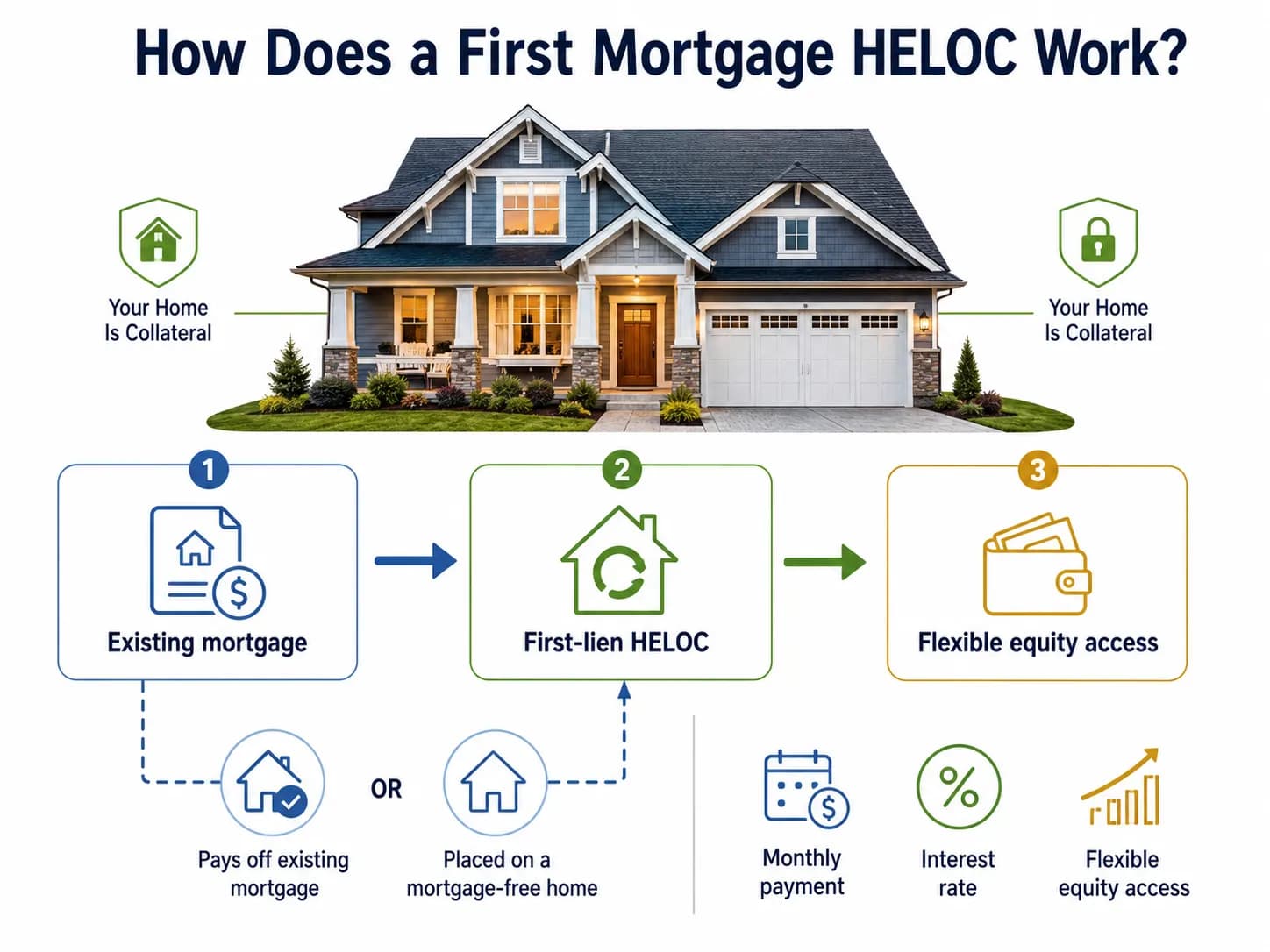
A First Mortgage HELOC is generally an open-end, revolving line of credit secured by a home and recorded in first-lien position. It may pay off an existing mortgage or become the first mortgage on a property that currently has no mortgage ahead of it.
The homeowner receives an approved credit limit rather than one lump sum. During the draw period, available funds may be borrowed, repaid, and potentially borrowed again, subject to the agreement.
The CFPB explanation of a home equity line of credit describes a HELOC as open-end credit that permits repeated borrowing against home equity. Because the property secures the account, missed payments or failure to repay may place the home at risk.
Interest is generally based on the outstanding balance. New draws increase that balance, and repeated borrowing can slow permanent principal reduction.
For a broader explanation of lien position, borrowing access, fees, and repayment risk, review the website’s complete First Mortgage HELOC guide.
What Should You Compare Between First Mortgage HELOC Lenders?
Compare the complete credit agreement, not only the advertised starting rate. Two lenders can display similar promotional APRs while using different margins, fees, payment formulas, draw requirements, or repayment schedules.
| First Mortgage HELOC factor | What it means | Why it matters | What to ask the lender |
|---|---|---|---|
| First-lien availability | The line holds senior priority on title | An existing mortgage may need to be paid off | Can this product be recorded in first position? |
| Property-location eligibility | The lender serves the property address | Availability can vary by state and ZIP code | Is my property location eligible? |
| Index | The benchmark used for a variable rate | Index changes may alter the APR | Which index does the agreement use? |
| Lender margin | The amount added to the index | Different margins create different pricing | What margin applies after any promotion? |
| Introductory APR | A temporary promotional APR | The payment may change when it expires | When does the introductory period end? |
| Ongoing APR | The APR after the promotional period | It may better reflect long-term borrowing cost | How is the ongoing APR calculated? |
| Draw period | The stage when advances may be available | Borrowing rules and minimum payments apply | How long can I draw funds? |
| Repayment period | The stage when principal must be repaid | Payments may increase after the draw period | How is the balance repaid? |
| Minimum payment | The smallest required periodic payment | It may not reduce much principal | Does the payment include principal? |
| Rate caps and floors | Contractual limits on rate movement | They affect potential payment changes | What are the periodic and lifetime limits? |
| Credit-line limit | The maximum approved line | The approved amount may differ from the request | What factors determine my limit? |
| LTV or CLTV | Secured debt compared with property value | Program limits can restrict available credit | Which value and lien balances are used? |
| Annual and closure fees | Costs for maintaining or closing the line | They affect the total cost | Which fees apply and when? |
| Property valuation | An appraisal or alternative value review | The supported value affects equity calculations | What valuation method is required? |
| Line suspension or reduction | Conditions may limit future borrowing | Available credit may not remain unchanged | When may the line be reduced or frozen? |
| Best next step | Review personalized written terms | Advertisements are not final offers | Can I compare a complete written estimate? |
The CFPB Home Equity Lines of Credit booklet provides a lender-comparison worksheet covering credit limits, index, margin, rate adjustments, draw periods, repayment periods, and fees. Use any advertised example only as a starting point because personalized terms depend on the complete application.

What Qualifications Do First Mortgage HELOC Lenders Review?
Lenders generally review both the borrower and the property. Home equity is necessary for many transactions, but equity alone does not establish the ability to repay or guarantee that the property and lien structure meet the lender’s requirements.
- Credit score, payment history, utilization, and recent credit activity
- Income, employment, and continuity of earnings
- Self-employment records, tax returns, or business statements when required
- Monthly debts and debt-to-income ratio
- Property value, current mortgage balance, and other liens
- LTV, CLTV, requested line amount, and planned initial draw
- Property type, occupancy, insurance, title, and underwriting findings
Homeowners can review their credit reports through AnnualCreditReport.com before applying. Correcting inaccurate report information may help the file reflect the borrower’s actual credit history, but a particular score does not ensure approval or pricing.
A high estimated property value does not mean all apparent equity is available. The lender may use a supported valuation, subtract existing secured debt, apply an LTV or CLTV limit, and then review repayment ability and product limits.
The website’s First Mortgage HELOC requirements guide explains how income, debts, equity, property review, documentation, and first-lien position may affect qualification.
How Are First Mortgage HELOC Rates and APRs Calculated?
Many HELOCs use a variable rate built from an index and a lender margin. The index is the benchmark named in the agreement, while the margin is the amount added under the lender’s product terms.
An introductory APR may apply for a limited period. After that period, the ongoing APR may be calculated using the current index plus the contractual margin, subject to any applicable floor, periodic cap, or lifetime cap.
- Which index does the product use?
- What margin applies?
- Is the advertised APR introductory or ongoing?
- When does the promotional period expire?
- How often can the APR adjust?
- What rate floor and caps apply?
- Are discounts conditional on automatic payments or another account?
- How would a higher balance or APR affect the required payment?
A lower starting APR does not automatically create the lowest long-term cost. Fees, the post-promotional formula, average balance, repayment behavior, and the length of time the account remains open can all affect the result.
Review the website’s First Mortgage HELOC rates and costs guide for a focused explanation of indexes, margins, payment changes, and comparison questions. Current rates should be verified and date-stamped rather than treated as permanent.
How Can the Draw and Repayment Periods Affect Payments?
The draw period is the stage when approved advances may be available. The repayment period begins when additional draws generally stop and the outstanding balance must be repaid under the account terms.
Some products may permit interest-only minimum payments during part of the draw period. An interest-only payment covers accrued interest but does not reduce principal. Other plans may require principal and interest from the beginning.
Payments may increase when the balance rises, the variable APR adjusts, a promotional rate expires, or principal repayment begins. A homeowner accustomed to a smaller draw-period payment may experience payment shock when the repayment period starts.
Ask the lender to show payment examples for a higher balance, a higher APR, the end of the draw period, and the beginning of principal repayment. Also confirm whether a balance could remain due at maturity and whether refinancing or renewal would require a new approval.
Additional explanations about equity, variable rates, draw access, and repayment are available in the website’s HELOC FAQ library. Access to future draws may be reduced or suspended under conditions permitted by the agreement and applicable rules.
Before replacing a stable mortgage payment with a revolving variable-rate account, review how the payment could behave through each stage. A personalized comparison can also test whether another equity or refinance option better matches your budget.
Compare First Mortgage HELOC Options
How Does a First Mortgage HELOC Compare With Other Equity Options?
A First Mortgage HELOC holds first-lien position and may replace the current mortgage. A second-lien HELOC generally leaves the original mortgage in place but creates another secured obligation.
A home equity loan commonly provides a lump sum with a defined repayment schedule. The CFPB explains the difference between a home equity loan and a HELOC, including lump-sum borrowing versus revolving access.
A cash-out refinance replaces the current mortgage with a new closed-end mortgage and may provide cash from equity. It reprices the entire balance, while a HELOC provides revolving access according to its draw rules. A rate-and-term refinance focuses on changing mortgage terms without the same revolving feature.
Keeping the current mortgage may also be reasonable, especially when it has favorable fixed terms. Homeowners should compare payment stability, closing costs, lien position, future borrowing access, repayment discipline, and long-term affordability rather than assuming flexibility is always preferable.
The CFPB explains how a HELOC may affect future refinancing, including lien and subordination considerations. The FTC guidance for comparing home equity credit also emphasizes that the home secures the debt and that borrowers should understand repayment obligations.
What Fees and Closing Costs Can a First Mortgage HELOC Include?
Possible costs may include application, origination, credit-report, appraisal, alternative valuation, title-search, title-insurance, recording, flood-certification, document-preparation, annual, maintenance, transaction, inactivity, and early-closure fees. Not every lender charges every fee.
A “no closing cost” HELOC may still contain conditions. The lender may absorb selected charges, require the line to remain open for a specified period, require reimbursement after early closure, exclude third-party costs, or use different pricing.
Compare upfront costs, ongoing account costs, conditional charges, the rate and margin, expected borrowing behavior, and the likely period the account will remain open. Request a written fee schedule and ask which charges apply at opening, during the draw period, during repayment, and when the line closes.
What Disclosures Should You Review Before Opening a HELOC?
A HELOC is generally open-end credit, so its disclosures may differ from the standard Loan Estimate and Closing Disclosure commonly used for many closed-end mortgages. The transaction-specific agreement and account-opening documents control the actual terms.
Review the APR, index, margin, adjustment method, promotional period, draw period, repayment period, minimum-payment formula, transaction requirements, fees, security interest, default terms, closure conditions, minimum draws, and line-reduction or suspension provisions.
The federal Regulation Z requirements for home-equity plans address disclosures and other requirements for HELOCs. Borrowers should still ask the lender to explain any term that is unclear and retain copies of all signed documents.
What Mistakes Should You Avoid When Comparing Local HELOC Lenders?
- Choosing a lender based only on map proximity
- Assuming every HELOC can hold first-lien position
- Assuming every lender serves Oklahoma or the property ZIP code
- Comparing only an introductory APR
- Ignoring the lender margin, rate floor, and rate caps
- Assuming interest-only payments reduce principal
- Ignoring repayment-period payment changes
- Overestimating available equity
- Assuming a credit score or CLTV guarantees approval
- Failing to verify licensing and property eligibility
- Ignoring annual, transaction, appraisal, and early-closure fees
- Replacing a fixed-rate mortgage without comparing long-term risk
- Borrowing repeatedly without a principal-repayment plan
- Assuming HELOC interest is automatically tax-deductible
- Signing before reviewing the complete agreement
Helpful insight: Compare the complete First Mortgage HELOC structure—not only the displayed APR. Review the index, lender margin, introductory period, ongoing APR, draw period, repayment period, payment calculation, fees, lien position, credit access, qualification requirements, and long-term affordability together.
How Might a First Mortgage HELOC Work for Different Oklahoma Homeowners?
What Might a Tulsa Homeowner With an Existing Fixed Mortgage Compare?
Consider a hypothetical Tulsa homeowner with equity and a fixed-rate mortgage. A first-lien HELOC could provide revolving access but replace fixed-rate stability with a variable APR.
The homeowner should compare the payoff, remaining term, closing costs, expected balance, margin, and possible rate changes with keeping the mortgage or using a second-lien product.
What Might a Mortgage-Free Broken Arrow Homeowner Compare?
A hypothetical mortgage-free Broken Arrow homeowner may want staged renovation funding. A First Mortgage HELOC could become the first recorded lien and permit draws as costs arise, subject to approval.
The homeowner should compare valuation, credit limit, fees, contractor timing, variable-rate risk, and repayment. Mortgage-free status does not remove qualification or collateral risk.
What Might a Self-Employed Jenks Homeowner Compare?
A hypothetical self-employed Jenks homeowner may value revolving credit during uneven income periods. Qualification may require tax returns, bank statements, business records, and adequate qualifying income.
The homeowner should model slower months, APR increases, reserves, future draws, and principal repayment rather than treating the line as permanent cash flow.

How Can You Prepare to Compare or Apply With a HELOC Lender?
Preparation helps lenders evaluate the same core information and makes written offers easier to compare. Gather documents and questions before relying on an online calculator or headline rate.
- Estimated property value and property address
- Current mortgage statement, payoff amount, and other liens
- Requested credit limit and expected initial draw
- Property type, occupancy, insurance, taxes, and HOA dues
- Credit history, income, employment, and self-employment records
- Bank statements, asset statements, monthly debts, and reserves
- Questions about the index, margin, promotion, caps, and floor
- Draw-period and repayment-period details
- Minimum-payment formula and possible maturity balance
- Valuation, title, closing-cost, annual-fee, and closure-fee details
- Alternative options, including a second-lien HELOC or refinance
- A long-term borrowing and principal-repayment plan
Jeff Leek’s mortgage FAQ library answers common Oklahoma loan questions, while the mortgage and home-equity articles provide additional planning information.
Tax treatment should be reviewed separately. The current IRS home mortgage interest deduction guidance explains federal rules, but deductibility depends on current law, use of proceeds, documentation, and individual circumstances. Consult a qualified tax professional.
A mortgage professional can help organize the property, equity, credit, income, and repayment information into a side-by-side comparison. This is especially useful before replacing an existing mortgage or assuming that a variable payment will remain affordable.
Compare First Mortgage HELOC Options
What Should You Verify Before Relying on This Guide?
This content is educational and is not a commitment to lend, personalized rate quote, legal advice, tax advice, investment advice, or accounting advice. First Mortgage HELOC product availability must be confirmed for the borrower, property, lien position, and location.
Approval, available equity, credit limit, interest rate, APR, payment, fees, closing costs, savings, draw access, timeline, and final terms are not guaranteed. Results depend on the lender, product, credit, income, employment, monthly debts, property value, existing liens, LTV, CLTV, occupancy, property type, title, documents, market conditions, and underwriting.
A HELOC is secured by the homeowner’s property. Failure to meet the credit agreement’s obligations may put the home at risk. Product guidelines, indexes, margins, fees, qualification standards, and tax rules can change.
Reviewed by: Jeff Leek
Reviewer NMLS: 303051
Last reviewed: June 23, 2026
What Do Homeowners Ask About First Mortgage HELOC Lenders Near Me?
What Is a First Mortgage HELOC?
It is generally an open-end home equity line recorded in first-lien position. It may replace an existing mortgage or become the first lien on a mortgage-free property.
How Is a First Mortgage HELOC Different From a Regular HELOC?
The distinction is lien position. A second-lien HELOC remains behind the existing mortgage, while a First Mortgage HELOC holds senior position and may pay off that mortgage.
Can a First Mortgage HELOC Replace My Current Mortgage?
It may if the transaction resolves the existing mortgage so the HELOC can be recorded first. Availability, approval, cost, and suitability depend on the lender and homeowner.
How Can I Find First Mortgage HELOC Lenders Near Me?
Confirm that a lender serves your property and offers a first-lien product. Then verify licensing, eligibility, qualification, pricing, fees, draw terms, repayment terms, and closing procedures.
What Qualifications Do First Mortgage HELOC Lenders Review?
Lenders may review credit history, income, employment, debts, property value, existing liens, LTV or CLTV, requested credit, occupancy, property type, title, insurance, assets, documentation, and underwriting findings.
Are First Mortgage HELOC Rates Fixed or Variable?
Many HELOCs use variable rates based on an index plus a lender margin. Some products may offer a temporary introductory APR or a fixed-rate conversion feature, but availability and terms vary.
What Fees Can a First Mortgage HELOC Include?
Possible charges include application, origination, valuation, appraisal, title, recording, annual, transaction, inactivity, maintenance, and early-closure fees. Ask for a complete written fee schedule because not every lender charges every item.
Is a First Mortgage HELOC Better Than a Cash-Out Refinance?
Neither option is automatically better. Compare variable versus fixed pricing, payment stability, closing costs, lien position, access to future funds, the effect on the existing mortgage, repayment behavior, and long-term affordability.