First Mortgage HELOC vs Home Equity Loan | Full Guide
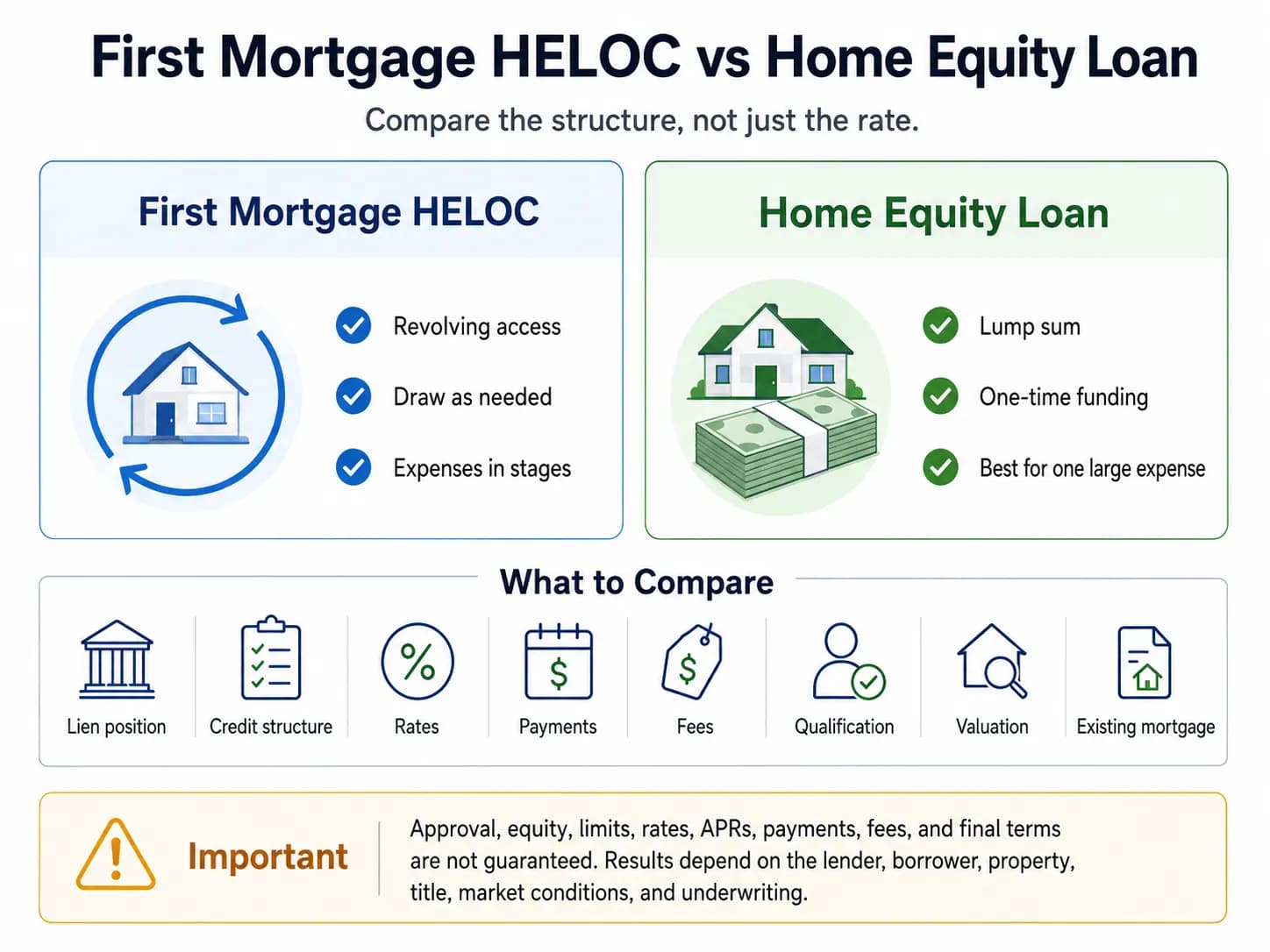
A Tulsa homeowner may need one renovation lump sum, while another expects expenses in stages. That distinction matters when comparing First Mortgage HELOC vs Home Equity Loan: one generally offers revolving access, while the other commonly provides a single lump sum.
Compare lien position, credit structure, rates, payments, fees, qualification, valuation, and the effect on an existing mortgage—not only the advertised rate.
Approval, available equity, credit limits, loan amounts, interest rates, APRs, payments, fees, closing costs, savings, and final terms are not guaranteed. Results depend on the lender, product, borrower, property, title, lien position, documentation, market conditions, and underwriting.
What Is the Difference Between a First Mortgage HELOC and a Home Equity Loan?
First Mortgage HELOC vs Home Equity Loan compares revolving, open-end credit in first-lien position with a closed-end loan that generally provides one lump sum and scheduled repayment. A HELOC often has a variable rate and changing payment, while a home equity loan commonly uses a fixed rate. Neither option is automatically better.
How Do a First Mortgage HELOC and a Home Equity Loan Compare at a Glance?
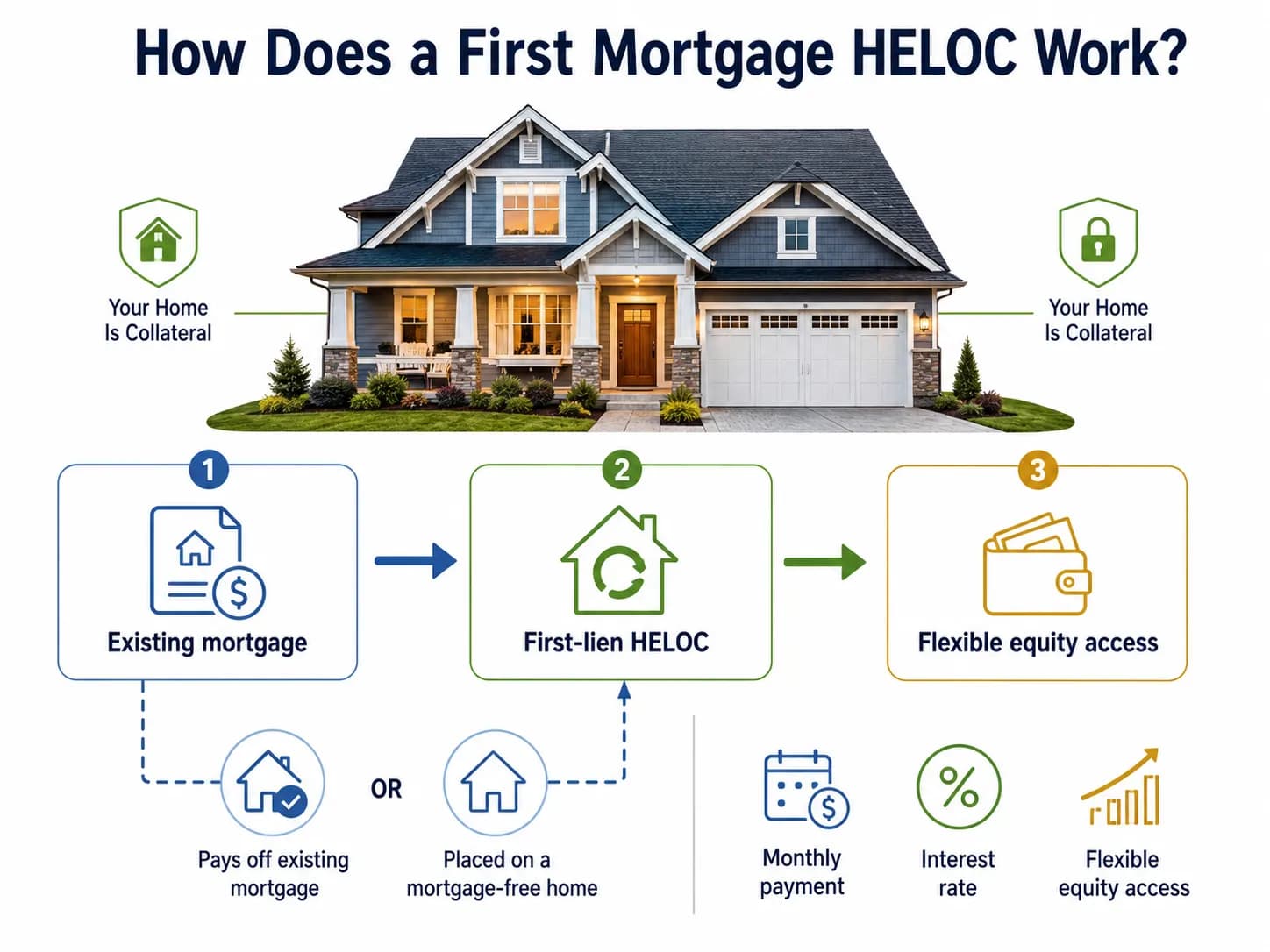
A First Mortgage HELOC is generally revolving credit in first-lien position. It may pay off an existing mortgage or become the senior lien on a mortgage-free property.
A home equity loan is generally closed-end credit: the borrower receives a defined amount and makes scheduled principal-and-interest payments. It commonly sits behind an existing first mortgage, although lien position depends on the transaction.
The CFPB comparison of home equity loans and HELOCs explains the basic distinction between a lump-sum loan and a reusable line of credit.
- A HELOC may allow repeated draws during an approved draw period.
- A home equity loan normally disburses the full loan amount once.
- Many HELOCs use variable rates and payments that can change.
- Home equity loans commonly use fixed rates and set repayment schedules, although terms vary.
- Both products are secured by the home and can create foreclosure risk if the borrower cannot repay.
For homeowners in Tulsa, Broken Arrow, Bixby, Jenks, Owasso, and nearby Oklahoma communities, the practical question is whether flexibility or predictability better matches the expense.
How Does a First Mortgage HELOC Work?
A First Mortgage HELOC is open-end revolving credit with an approved limit and permitted draws. Its defining feature is first-lien position. An existing mortgage may need to be paid off or resolved so the HELOC can become the senior lien.
The CFPB explanation of a home equity line of credit describes a HELOC as open-end credit that allows repeated borrowing against home equity.
Interest is generally charged on the outstanding balance. Repaid principal may become available again during the draw period, but future access is not guaranteed, and advances may be reduced or suspended when permitted.
Many products use a variable APR based on an index plus a lender margin. Payments may change with the index, balance, formula, or repayment stage. Interest-only minimum payments, when offered, do not reduce principal.
The website’s complete First Mortgage HELOC guide provides more detail about lien position, draw access, repayment, fees, and risks.
How Does a Home Equity Loan Work?
A home equity loan is generally closed-end credit secured by the property. It provides a defined lump sum with scheduled repayment.
The CFPB explanation of a home equity loan notes that the borrower receives the funds in one lump sum and that the product usually has a fixed interest rate.
It is commonly a second mortgage when another first lien remains, but it could occupy first position when no prior mortgage remains. Interest generally begins on the disbursed balance, and repaid principal does not replenish available credit.
A fixed-rate structure can make principal-and-interest payments easier to plan, but it does not guarantee the lowest total cost. Taxes, insurance, and HOA expenses may still change.
What Should Homeowners Compare Side by Side?
The comparison should reflect the complete written terms rather than a headline rate or estimated monthly payment.
| Comparison factor | First Mortgage HELOC | Home Equity Loan | Why it matters |
|---|---|---|---|
| Credit structure | Generally open-end and revolving | Generally closed-end | Determines whether credit can be reused |
| How funds are received | Draws up to available credit | One lump-sum disbursement | Should match the timing of expenses |
| Lien position | First lien | Often second lien if a mortgage remains | Affects the existing mortgage and title |
| Existing mortgage treatment | May need to be paid off | May remain in place | Can change the rate exposure on existing debt |
| Interest-rate structure | Often variable | Commonly fixed | Affects payment stability |
| APR behavior | May change with the index and margin | Usually established at closing when fixed | Changes long-term borrowing cost |
| Payment predictability | Can change with balance, rate, and stage | Generally more predictable when fixed | Important for household budgeting |
| Draw period | Usually included | Not applicable | Controls when additional borrowing is allowed |
| Repayment period | Follows draw-period rules | Begins with the scheduled loan term | Determines when principal is repaid |
| Ability to borrow again | May be available during the draw period | Not normally available | Relevant for recurring expenses |
| Interest charged | Generally on the outstanding balance | Generally on the full disbursed balance | Affects cost when funds are used gradually |
| Principal repayment | Depends on the payment formula and stage | Usually included in scheduled payments | Affects balance reduction |
| Credit limit or loan amount | Approved maximum line | Defined original loan amount | The approved amount may differ from the request |
| Rate caps and floors | May apply to variable pricing | Less relevant when the rate is fixed | Limits do not make a variable payment fixed |
| Loan term | Draw and repayment stages | Set amortization term | Changes repayment timing |
| Closing costs | May include opening and third-party charges | May include closed-end loan costs | Upfront costs affect value |
| Ongoing fees | Annual, transaction, or inactivity fees may apply | Usually fewer account-maintenance fees | Ongoing charges affect total cost |
| Line reduction or suspension | May occur when permitted | Not a revolving line | Future HELOC access is not guaranteed |
| Best suited for | Potentially staged or recurring expenses | Potentially one defined expense | The borrowing purpose should drive the choice |
| Primary risk | Changing rates, payments, and repeated borrowing | Borrowing a full lump sum and fixed obligation | Both debts are secured by the home |
| Best next step | Review personalized line terms | Review personalized loan terms | Advertisements are not final offers |
Which Option Offers More Rate and Payment Predictability?
Home equity loans commonly provide more predictable principal-and-interest payments when they use a fixed rate and fully amortizing schedule.
Many First Mortgage HELOCs use a variable rate. The agreement identifies an index and a lender margin. When the index changes, the rate may adjust according to the contract, subject to any floor or cap.
An introductory APR may be temporary. Ask when it ends, how the ongoing APR is calculated, how often adjustments can occur, and whether discounts are conditional.
Payments may also rise when the balance increases or the draw period ends and principal repayment begins.
The CFPB Home Equity Lines of Credit booklet includes comparison points for the index, margin, adjustment frequency, rate caps, draw period, repayment period, and fees.
For a focused explanation of variable pricing, review how First Mortgage HELOC rates work. A fixed payment may support budgeting, while a variable line may offer flexibility, but neither feature guarantees lower total cost.
Which Option Provides More Flexible Access to Home Equity?
A HELOC may fit phased renovations, recurring education costs, or irregular expenses because the borrower can draw only what is needed during the approved period.
A home equity loan may fit a known one-time expense. The full amount is generally disbursed at closing, so interest usually begins on the outstanding lump-sum balance.
Flexibility has a tradeoff. Repeated HELOC draws can slow principal reduction, increase the balance, and make repayment less predictable. A homeowner should not borrow simply because credit is available.
The website’s HELOC FAQ library answers common questions about draw periods, available credit, repayment, rates, and home equity.
A personalized comparison can match the timing of the expense with the borrowing structure. It can also test whether a one-time loan, revolving line, or no new debt is more manageable.
Compare My Home Equity Options

How Do Qualification Requirements Compare?
Lenders review the borrower, property, and proposed lien structure for both products. Equity alone does not guarantee approval.
- Credit score, payment history, credit utilization, and recent credit activity
- Income, employment, and continuity of earnings
- Self-employment documentation such as tax returns or business records when required
- Monthly debts and debt-to-income ratio
- Property value, current mortgage balance, and other liens
- Loan-to-value ratio and combined loan-to-value ratio
- Property type, occupancy, insurance, title, and underwriting findings
- Requested HELOC limit, requested loan amount, and expected initial use
LTV compares secured debt with the supported value; CLTV considers combined liens. Some lenders evaluate a HELOC using the full limit rather than only the opening draw.
The approved amount may be lower than requested because of valuation, credit, income, debts, title findings, or product limits.
The website’s First Mortgage HELOC requirements guide explains how credit, income, equity, property review, and lien position may affect a first-lien application.

How Do Fees and Closing Costs Compare?
Both products may include application, origination, credit-report, valuation, appraisal, title-search, title-insurance, settlement, recording, flood-determination, document, or existing-mortgage payoff charges. Not every lender charges every item.
A HELOC may also include annual, transaction, inactivity, fixed-rate conversion, or early-closure fees. A home equity loan may have more traditional closed-end origination and settlement costs without ongoing line-maintenance charges.
“No closing cost” does not always mean no cost exists. The lender may absorb selected charges, use different pricing, exclude third-party fees, or require reimbursement when the account closes within a stated period.
Compare upfront charges, ongoing fees, conditional costs, expected account duration, rate structure, expected average balance, and repayment behavior. Request written estimates for the actual product rather than relying on a generic website example.
How Do Disclosures Differ Between the Two Products?
A HELOC is generally open-end credit. Its application and account-opening disclosures may address the index, margin, variable APR, payment calculation, draw period, repayment period, fees, minimum transactions, credit-line restrictions, and circumstances that may limit additional advances.
The Regulation Z requirements for home-equity plans address disclosures and other rules for open-end home-equity credit.
A home equity loan is generally closed-end credit. Depending on the transaction and applicable requirements, the borrower may receive disclosures commonly associated with closed-end mortgages, including a Loan Estimate and Closing Disclosure.
Homeowners should not assume that both products use identical forms or timing. The written documents for the actual transaction control the rate, payment, fees, lien, rescission rights when applicable, default provisions, and repayment obligations.
What Risks Should Homeowners Compare?
A First Mortgage HELOC can create variable-rate, payment-change, re-borrowing, line-reduction, and repayment-shock risks. Replacing a favorable fixed mortgage also sacrifices predictable pricing.
A home equity loan can encourage borrowing more than needed because the full amount is disbursed at once and creates a fixed repayment obligation.
Both products convert home equity into debt secured by the property. The FTC guidance for home equity loans and lines of credit emphasizes reviewing repayment obligations and the risk to the home.
Shared risks include foreclosure, falling property values, refinance limitations, title complications, and moving unsecured debt onto the home without changing spending behavior.
Homeowners should also compare other financing options similar to a HELOC, such as a home equity loan or cash-out refinance. Keeping the existing mortgage and avoiding new debt may also be reasonable.
What Common Comparison Mistakes Should Homeowners Avoid?
- Comparing only the advertised rate or opening payment
- Assuming every HELOC can occupy first-lien position
- Assuming every home equity loan must be a second mortgage
- Assuming every HELOC is variable or every home equity loan is fixed
- Ignoring the HELOC index, margin, floor, and caps
- Ignoring the expiration of an introductory rate
- Assuming interest-only payments reduce principal
- Ignoring payment changes when the draw period ends
- Borrowing a larger lump sum than the planned expense requires
- Ignoring annual, inactivity, conversion, or early-closure fees
- Assuming home equity or a strong credit score guarantees approval
- Ignoring LTV, CLTV, valuation, title, and property requirements
- Assuming available HELOC credit can never be reduced
- Replacing a favorable mortgage without comparing the lost terms
- Converting unsecured debt into home-secured debt without a repayment plan
- Assuming interest is automatically tax-deductible
- Treating an online calculator as a personalized offer
Helpful insight: Compare the purpose and timing of the funds, rate structure, payment predictability, lien position, fees, expected balance, repayment behavior, existing mortgage terms, and long-term affordability together. Neither a First Mortgage HELOC nor a home equity loan is universally superior.
Which Option May Fit Different Oklahoma Homeowner Situations?
Could a Tulsa Homeowner Use a HELOC for Renovations Completed in Stages?
This hypothetical homeowner expects contractor invoices over several months. Revolving access could match staged costs, but the homeowner should compare variable-rate risk, fees, project overruns, and repayment after the draw period.
Could a Broken Arrow Homeowner Use a Home Equity Loan for One Defined Expense?
This hypothetical homeowner needs one established amount and values predictable repayment. The comparison should include closing costs, amortization, lien position, and whether the requested amount exceeds the actual need.
Should a Jenks Homeowner Replace a Favorable Mortgage With a First-Lien HELOC?
This hypothetical homeowner has a favorable fixed mortgage. Replacing it with a first-lien HELOC could expose the balance to variable pricing. Compare keeping the mortgage, adding a second-lien product, or refinancing based on cost and payment tolerance.
How Can You Prepare to Compare or Apply?
Preparation makes written proposals easier to compare. Start with the property, current mortgage, planned use, and repayment strategy.
- Estimated property value and property address
- Current mortgage balance, rate, term, payment, and payoff amount
- Other liens recorded against the property
- Requested HELOC limit or home equity loan amount
- Expected initial HELOC draw and timing of future expenses
- Property type, occupancy, insurance, taxes, and HOA dues
- Credit history, income, employment, and self-employment documents
- Bank statements, asset statements, monthly debts, and reserves
- HELOC index, margin, promotion, cap, floor, and payment questions
- Draw period, repayment period, loan term, and amortization details
- Valuation, title, closing-cost, annual-fee, and early-closure information
- Alternative options and a long-term principal-repayment plan
Homeowners can review Jeff Leek’s Oklahoma mortgage guidance, explore the mortgage FAQ library, and read additional mortgage and home-equity articles before requesting a personalized comparison.
Verify a mortgage professional through NMLS Consumer Access and review Oklahoma mortgage-lender licensing information when comparing providers.
Tax treatment should be reviewed separately. IRS home mortgage interest deduction guidance provides federal information, but deductibility depends on current law, use of proceeds, documentation, and individual circumstances. Consult a qualified tax professional.
A mortgage professional can organize rates, fees, lien position, qualification, and repayment into a side-by-side review before new debt is secured by the home.
Compare My Home Equity Options
What Should Readers Verify Before Relying on This Guide?
This content is educational and is not a commitment to lend, personalized rate quote, or individualized legal, tax, investment, accounting, or financial advice. Product availability must be confirmed for the borrower, property, lien position, and location.
Approval, available equity, credit limits, loan amounts, interest rates, APRs, payments, fees, closing costs, savings, and final terms are not guaranteed. Results depend on the lender, product, credit history, income, employment, debt-to-income ratio, property value, existing liens, LTV, CLTV, occupancy, property type, insurance, title, documentation, market conditions, and underwriting.
Both products are secured by the home. Failure to meet the agreement’s obligations may put the property at risk. Guidelines, products, rates, margins, fees, and tax rules can change.
Last Updated: June 24, 2026
Reviewed By: Jeff Leek, NMLS 303051
What Do Homeowners Ask About First Mortgage HELOC vs Home Equity Loan?
What Is the Main Difference Between a First Mortgage HELOC and a Home Equity Loan?
A First Mortgage HELOC generally offers revolving first-lien credit; a home equity loan generally provides one lump sum with scheduled repayment. Terms vary.
Does a First Mortgage HELOC Replace My Current Mortgage?
It may pay off an existing mortgage to become the first lien, subject to availability, title review, qualification, and approval.
Is a Home Equity Loan Always a Second Mortgage?
No. It is commonly second-lien credit when a first mortgage remains, but it may occupy first position when no prior lien remains.
Which Option Usually Has a Fixed Interest Rate?
Home equity loans commonly use fixed rates. Many HELOCs are variable, although fixed-rate segments or conversions may be available.
Which Option Lets Me Borrow Money More Than Once?
A HELOC may allow repeated draws during the draw period. A home equity loan normally provides one disbursement and does not replenish.
Which Option May Offer More Predictable Payments?
A fixed, fully amortizing home equity loan generally offers more predictable payments. HELOC payments may change with rate, balance, or repayment stage.
Do a HELOC and Home Equity Loan Have the Same Qualification Requirements?
Both may require credit, income, debt, equity, valuation, title, insurance, and property review, but standards can differ.
Is a First Mortgage HELOC Better Than a Home Equity Loan?
Neither is automatically better. Compare the funding purpose, timing, mortgage terms, rate tolerance, costs, qualification, and repayment plan.