VA IRRRL Refinance | Get Your Lower Your Mortgage Rate Now
Being told that you need a VA Loan Certificate of Eligibility can create more questions than answers. You may wonder where to request it, what records you need, whether prior VA loan use matters, and whether receiving the certificate means your mortgage is approved.
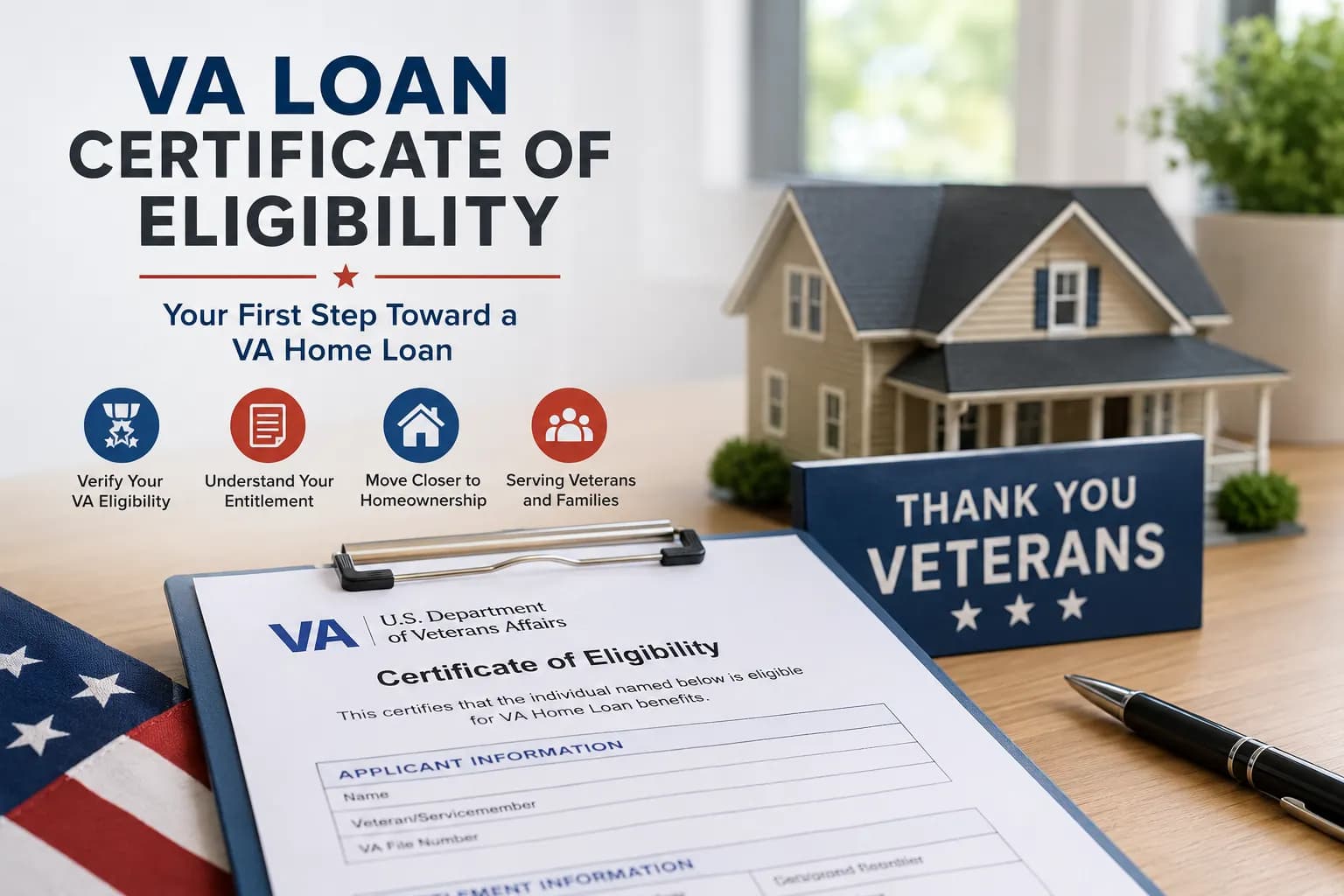
A VA COE confirms that the U.S. Department of Veterans Affairs has determined that you meet the service-related requirements for the VA home loan benefit. A lender may help request it, but the certificate does not approve your credit, income, property, interest rate, payment, or final loan.
Quick answer: A VA Loan Certificate of Eligibility is an official document from the Department of Veterans Affairs confirming that an applicant meets the service-related requirements for the VA home loan benefit. It helps a lender verify VA eligibility, but it is not mortgage pre-approval, property approval, or final underwriting approval.
This guide explains who may qualify, how to request a COE, which military records may be needed, how entitlement works, what can delay a request, and what to do next. It also covers active-duty, National Guard, Reserve, surviving-spouse, and repeat-use situations for borrowers in Tulsa, across Oklahoma, and in other licensed markets.
Individual results vary. Eligibility, available entitlement, credit, income, debts, assets, occupancy, property condition, appraisal results, lender standards, and underwriting all affect the complete loan process.
What Is a VA Loan Certificate of Eligibility?
A VA Loan Certificate of Eligibility, commonly called a COE, is issued by the Department of Veterans Affairs. It tells a lender that VA has reviewed available information and determined that the applicant meets the service-related eligibility requirements for a VA direct or VA-backed home loan benefit.
The COE matters because a private lender generally needs it before completing a VA-backed mortgage. Borrowers can review the current VA home loan eligibility guidance for official information about service history, duty status, and qualifying exceptions.
The certificate does not complete the mortgage review. It addresses benefit eligibility and entitlement information, while a lender separately evaluates the borrower and the property.
- Benefit eligibility: VA determines whether service-related requirements are met.
- Available entitlement: The COE may show entitlement information connected to the VA guaranty.
- Borrower qualification: The lender reviews credit, income, employment, assets, debts, residual income, and occupancy.
- Property approval: The lender and VA appraisal process review the property, value, and applicable Minimum Property Requirements.
- Final approval: Underwriting reviews the complete file and any outstanding conditions.
For example, a Tulsa Veteran may receive a COE before shopping for a primary residence. The document confirms access to the benefit, but the borrower still needs lender pre-approval, an acceptable property, an appraisal, title review, and final underwriting.
Borrowers can review the broader VA loan requirements that apply after benefit eligibility has been established.
Review Your VA Loan Eligibility
Who May Qualify for a VA Home Loan COE?
A COE may be available to Veterans, current service members, certain National Guard or Reserve members, eligible surviving spouses, and other applicants recognized under current VA rules. Qualification depends on the individual record rather than military status alone.
VA may consider service dates, length of service, duty status, qualifying activation, character of discharge, and exceptions connected to the reason for separation. Because service requirements vary by service period and category, borrowers should avoid relying on a simple statement such as “all Veterans qualify.”
Common applicant categories include:
- Veterans with qualifying active-duty service and an eligible character of discharge
- Active-duty service members who meet current minimum service requirements
- National Guard members whose service meets current VA criteria
- Reserve members whose service meets current VA criteria
- Certain unmarried or otherwise eligible surviving spouses
- Applicants who may qualify under a current exception reviewed by VA
An applicant with a discharge that may affect eligibility can still submit a request so VA can review the record. A mortgage company should not make a final benefits determination based only on a brief description of the applicant’s service.
Even after VA issues a COE, the lender must still decide whether the borrower meets the mortgage program’s credit, income, occupancy, property, and underwriting requirements.
How Can You Request a VA Certificate of Eligibility?
You can generally request a COE online, ask a VA-approved lender to request it, or apply by mail. The best method depends on your records, service category, access to VA.gov, and whether the request needs manual review.
VA’s official instructions for requesting a COE describe the three main paths.
- Request it online through VA.gov. Sign in, provide the requested information, and upload supporting records if VA asks for them. Some applicants may receive a decision using records already available to VA, while others need additional review.
- Ask your lender to request it. A VA-approved lender may use VA’s lender system to retrieve an existing certificate or submit a request. This can be convenient when you are already preparing for pre-approval.
- Apply by mail. Complete the current official VA Form 26-1880 and send it to the address listed on the form. Mail requests may take longer than online or lender-assisted requests.
You may already have an active COE if you previously requested one or used the VA home loan benefit. In that situation, VA.gov or the lender system may allow you to retrieve it rather than begin a completely new request.
Some files cannot be completed automatically because service data, prior entitlement, surviving-spouse information, or other records need review. No request method guarantees immediate issuance.
After submitting a request, borrowers can use the VA COE status tool to review the request stage, read VA letters, upload requested documents, and download an approved certificate.
The status page states that VA’s goal is to contact applicants in an average of five business days, but that is a service goal rather than a guaranteed decision time.
A VA loan specialist may help borrowers organize the required records and understand which questions should be directed to VA.
What Documents Might You Need for a VA COE?
The documents depend on your service category, current duty status, discharge history, prior VA loan use, and whether VA already has enough electronic information. Do not submit every military document you own unless VA or your lender asks for it.
What May a Veteran Need?
A Veteran may need a copy of DD Form 214 or another acceptable separation document showing service information and character of discharge. VA may request additional information when the record is incomplete, inconsistent, or unavailable electronically.
What May an Active-Duty Service Member Need?
An active-duty applicant may need a current Statement of Service signed by an authorized official. The statement commonly identifies the service member, date of birth, Social Security number or service number, entry date, duration of lost time if any, and the command providing the information.
What May a National Guard or Reserve Member Need?
Documentation may include a Statement of Service, NGB Form 22, NGB Form 23, proof of honorable service, or a current retirement-points statement, depending on whether the applicant is serving, discharged, activated, or never activated. VA reviews the applicant’s actual service record under current rules.
What May an Eligible Surviving Spouse Need?
An eligible surviving spouse may need different forms depending on whether Dependency and Indemnity Compensation is already being received. VA’s home loan guidance for surviving spouses explains the current process.
When DIC is already being received, the applicant may need the official VA Form 26-1817 and available discharge or separation papers. Other situations may require a DIC application, marriage documentation, and the Veteran’s death certificate.
| Applicant Type | Common Documentation | Important Note |
|---|---|---|
| Veteran | DD Form 214 or other separation records | VA may request more information if records are incomplete. |
| Active duty | Current signed Statement of Service | The statement should contain the details required by current VA guidance. |
| National Guard or Reserve | NGB forms, points statement, or proof of honorable service | Requirements depend on status and activation history. |
| Eligible surviving spouse | Applicable VA form, separation records, and supporting relationship or death records | The process differs based on DIC status and the individual case. |
If you do not have a DD Form 214 or another needed service record, review the National Archives military-record request guidance. Keep copies of every record, form, letter, and upload confirmation connected to the request.

What Information Appears on a VA Certificate of Eligibility?
A COE commonly includes applicant information, eligibility status, entitlement details, notes or conditions, and information connected to prior VA loan use. The exact format and fields may change, so borrowers should review the current document rather than rely on an old sample found online.
The entitlement section often creates the most confusion. Entitlement is connected to the amount of guaranty VA may provide to the lender; it is not a cash balance, a home-buying budget, or an approved loan amount.
The document may show:
- Applicant name and identifying information
- Eligibility status
- Basic, used, remaining, or restored entitlement information
- Prior VA-backed loan information where applicable
- Conditions that require lender or VA attention
- Funding-fee status or exemption-related information where shown
A borrower should not interpret one entitlement number without considering whether a prior VA-backed loan remains open, whether another borrower assumed the loan, whether the property was sold, whether VA restored entitlement, or whether a prior guaranty claim remains charged.
A COE confirms access to the VA home loan benefit, but the entitlement section may require lender review before a borrower knows how it affects a specific purchase.
Funding-fee information should also be reviewed rather than assumed. A disability claim, compensation decision, surviving-spouse status, or updated VA record may affect what appears on the certificate, but the current file and official VA determination control.
The complete VA funding fee guide explains possible exemptions, payment options, refund situations, and differences among purchase, refinance, construction, and assumption transactions.
How Is a VA COE Different From Mortgage Pre-Approval?
A VA COE addresses benefit eligibility. Mortgage prequalification and pre-approval address the borrower’s financial profile, while final approval considers the complete borrower, property, title, appraisal, and underwriting file.
The differences are practical:
| Step or Document | What It Shows | What It Does Not Guarantee |
|---|---|---|
| VA Certificate of Eligibility | VA home loan benefit eligibility and entitlement information | Mortgage approval, rate, payment, property acceptance, or closing |
| Mortgage prequalification | An early estimate based on information provided by the borrower | Verified qualification or final approval |
| Mortgage pre-approval | A more detailed lender review of financial documentation and credit | Final property approval, appraisal result, or unconditional closing |
| Final loan approval | The file has met lender and underwriting requirements, subject to any final closing conditions | A completed closing before documents are signed and funds are disbursed |
A lender may still review credit history, qualifying income, employment, assets, debts, debt-to-income ratio, residual income, occupancy, property type, purchase contract, appraisal, title, insurance, and other underwriting conditions.
A COE does not establish the interest rate or monthly payment. It does not approve the property, guarantee no down payment, or guarantee that a purchase will close.
Borrowers preparing for the next step should review the full VA mortgage qualification requirements and gather the documents requested by their lender.
Review Your VA Loan Eligibility
Can You Use a VA Loan Benefit More Than Once?
Yes, the VA home loan benefit may be reusable. Prior use does not automatically remove future eligibility, but it can affect how much entitlement is currently available and whether restoration is needed.
A repeat borrower may have:
- Full entitlement: No entitlement is currently charged, or prior entitlement has been restored under current VA rules.
- Remaining entitlement: Some entitlement remains available even though another VA-backed loan or prior use is reflected.
- Entitlement requiring restoration: The borrower may need VA to update the COE after a prior loan is paid, the property is sold, or another qualifying event occurs.
An outstanding VA-backed mortgage can affect available entitlement. A prior loan assumption can also matter because entitlement may remain connected to the original borrower unless an eligible person who assumes the loan substitutes their own entitlement and the required release is completed.
The VA loan assumption guide explains why seller liability, buyer qualification, substitution of entitlement, and entitlement release should be reviewed before an assumption closes.
Foreclosure, short sale, deed in lieu, compromise claim, or another loss to VA can affect entitlement differently from a normal payoff. Borrowers should not assume that paying off a mortgage automatically updated the COE; the restoration request and supporting records may still need review.
VA may allow limited restoration in certain situations under current rules. Because the outcome depends on the prior loan and the borrower’s history, VA and the lender should review the actual certificate rather than relying on a universal formula.
Why Might a VA COE Request Be Delayed or Require More Review?
A COE request may need manual review when electronic records are incomplete or when the file includes prior entitlement, surviving-spouse, discharge, or service-history questions. A delay does not automatically mean the applicant is ineligible.
Common reasons include:
- Missing DD Form 214 or discharge records
- An incomplete or outdated Statement of Service
- Service history that is not available electronically
- Name, date-of-birth, or identifying-information mismatches
- National Guard or Reserve records that do not show enough qualifying information
- Surviving-spouse documentation that requires further review
- Prior entitlement that remains charged
- A previous VA-backed loan that is not reflected as paid
- A loan assumption connected to the prior entitlement
- A restoration request or prior guaranty claim
- Funding-fee-status questions
- A mailed request, portal issue, or requested document upload
Start by reviewing the information submitted and any VA letter in the online status system. Gather the requested records, confirm that names and identifying details match, and ask your lender whether the request needs an updated document or entitlement review.
Do not submit multiple conflicting requests simply because the first one is taking longer than expected. VA’s status guidance says that a duplicate request does not make the existing review move faster.
What Should You Do After Receiving Your VA Certificate of Eligibility?
After receiving the COE, review it for accuracy and connect it to lender pre-approval. Getting the document early may reveal an entitlement, service-record, or funding-fee-status question before you make an offer.
- Confirm that your name and identifying information are correct.
- Review the eligibility and entitlement sections.
- Ask about any condition, note, or unfamiliar prior-loan entry.
- Confirm whether updated service or entitlement records are needed.
- Begin or continue lender pre-approval.
- Provide income, employment, asset, debt, and identification documents.
- Review an affordable purchase range rather than treating the COE as a budget.
- Discuss estimated closing costs and possible VA funding-fee treatment.
- Work with a real estate professional who understands your timeline and financing.
- After an accepted offer, complete the appraisal, title, insurance, and underwriting steps.
- Review the Loan Estimate and Closing Disclosure carefully.
- Satisfy remaining conditions before signing closing documents.
VA’s official home-buying process explains that borrowers generally work with a private lender for a VA-backed purchase loan. VA guarantees part of the loan rather than acting as the lender for a standard VA-backed purchase transaction.
The VA-backed purchase-loan requirements also explain that the borrower must meet lender standards and use the property as a primary residence. Eligibility does not remove lender or property requirements.
For a broader official overview, borrowers can review the VA Home Loan Guaranty Buyer’s Guide.
A qualified borrower comparing next steps may also find these resources helpful:
- Work with a VA loan specialist when entitlement, costs, or lender requirements need explanation.
- Review how a VA loan with no down payment may work, while remembering that zero-down financing is not guaranteed in every scenario.
- Explore a VA construction loan when building a primary residence instead of buying a completed home.
- Compare other mortgage programs when VA financing may not be the best fit for the property, timeline, or complete borrower profile.
Why Should Closing Costs Be Reviewed Separately?
The COE does not show the borrower’s complete Cash to Close calculation. Lender charges, prepaid items, title expenses, allowable seller credits, funding-fee treatment, escrow deposits, and other transaction costs should be reviewed through the Loan Estimate and final disclosures.
The complete VA loan closing-cost guide explains the difference between closing costs, prepaid expenses, the funding fee, earnest money, credits, and final Cash to Close.
Does the COE Guarantee a No-Down-Payment Loan?
No. A qualified borrower may be able to purchase a primary residence without a traditional down payment, but that outcome depends on available entitlement, borrower qualification, lender requirements, the purchase price, and the property’s supported value.
The VA Loan No Down Payment guide explains when zero-down financing may be available, when a down payment may still be needed, and why buyers can still have upfront costs.
How Can Jeff Leek Help Tulsa VA Borrowers?
Jeff Leek can help eligible borrowers connect the COE to the rest of the mortgage process. He may help request or retrieve a certificate through the lender process, review the information displayed, identify questions that may require updated records, and prepare the borrower for financial and property review.
Support may include:
- Reviewing the COE and available entitlement information
- Explaining the difference between eligibility and mortgage approval
- Preparing for credit, income, asset, debt, and residual-income review
- Comparing VA financing with available FHA, Conventional, USDA, or other options
- Reviewing estimated closing costs and possible funding-fee treatment
- Preparing for appraisal, title review, insurance, and underwriting
- Coordinating next steps with the borrower and real estate professionals
Jeff Leek does not issue the Certificate of Eligibility. VA makes the benefit-eligibility determination, and mortgage approval remains subject to lender review, program requirements, property review, and underwriting.
Borrowers can use the website’s loan comparison calculator to explore educational scenarios involving VA, FHA, Conventional, USDA, Section 184, and other mortgage options. Calculator results are not loan quotes or approval decisions.
What Questions Do Borrowers Ask About a VA Loan Certificate of Eligibility?
What Is a VA Loan Certificate of Eligibility?
It is an official VA document confirming that an applicant meets the service-related eligibility requirements for the VA home loan benefit. It also may show entitlement and prior-use information, but it is not mortgage approval.
Does a VA COE Guarantee Loan Approval?
No. The lender still reviews credit, income, employment, debts, assets, residual income, occupancy, property, appraisal, title, insurance, and underwriting conditions.
How Can I Request My VA Certificate of Eligibility?
You can generally request it through VA.gov, ask a VA-approved lender to request it, or apply by mail using the current VA Form 26-1880. Additional records may be required.
How Long Does It Take to Receive a VA COE?
Timing varies. VA describes a goal of contacting applicants in an average of five business days, but manual review, missing records, mail, or entitlement questions can take longer.
Does a VA Certificate of Eligibility Expire?
A COE is not commonly treated like a short-term pre-approval letter, but it may need updating when service information, disability status, entitlement, or prior-loan details change. A lender can review whether a current certificate is usable.
Can I Get Another VA Loan if I Used My Benefit Before?
Possibly. You may have full entitlement, remaining entitlement, or entitlement that can be restored when current VA requirements are met. The prior loan and current COE need review.
What Should I Do if My COE Shows Used Entitlement?
Ask your lender to review the prior-loan information and determine whether the entitlement is still charged, whether remaining entitlement may be available, or whether a restoration request is appropriate.
Can an Eligible Surviving Spouse Get a VA COE?
Certain surviving spouses may qualify under current VA rules. The required form and supporting documents depend partly on DIC status and the individual circumstances, and VA makes the final determination.
What Should Borrowers Know Before Relying on This Guide?
This article is for general mortgage and VA home loan education. It is not legal, financial, benefits, military-record, or lending advice. The U.S. Department of Veterans Affairs determines Certificate of Eligibility status, while lenders evaluate mortgage qualification and underwriting.
VA requirements, forms, entitlement rules, processing times, funding-fee guidance, lender standards, and program details can change. Borrowers should verify current information with VA and a licensed mortgage professional before making a financial decision.
Jeff Leek is not affiliated with or endorsed by the U.S. Department of Veterans Affairs. All loans are subject to credit approval, program eligibility, property review, and underwriting. This is not a commitment to lend.
What Is the Best Next Step After Reviewing Your COE?
Your COE confirms access to the VA home loan benefit, but it does not confirm the loan amount, rate, monthly payment, property, down-payment outcome, or final approval. Entitlement and prior VA loan use may need lender or VA review before you know how the benefit applies to a specific purchase.
The practical next step is mortgage pre-approval based on your complete financial profile and home-buying plan. Jeff Leek can help qualified Tulsa and Oklahoma borrowers review the COE, prepare lender documents, compare loan options, and understand the remaining steps without treating eligibility as a promise of approval.
Review Your VA Loan Eligibility
Additional answers about eligibility, entitlement, funding fees, closing costs, repeat benefit use, and refinancing are available in the website’s VA loan FAQ library.
Readers can also explore the full collection of VA loan and mortgage articles for related guidance about qualification requirements, no-down-payment financing, closing costs, funding fees, assumptions, construction loans, and other home-financing topics.